Why Do Dogs Eat Grass? Rate Your Dog's Grass Habit (1 to 5)
By BEANS Team · Published
TL;DR
Eating grass is mostly normal dog behaviour. In a survey of 1,571 plant-eating dogs, only about 9% often seemed ill beforehand and 22% regularly vomited afterwards. Why they do it is still a hypothesis: inherited instinct or taste. Skip sprayed lawns and unknown plants, and see your vet for repeated vomiting, poor appetite or frantic eating.
- A 2008 UC Davis study concluded plant eating is a normal behaviour of domestic dogs
- Of 1,571 plant-eating dogs, about 9% often seemed ill before and 22% regularly vomited after
- Inherited instinct from wild ancestors and simple taste are the leading ideas, but both are hypotheses
- Sprayed grass, toxic plants and droppings are the real risks, so stick to grass you know
- Repeated vomiting, going off food, lethargy or frantic grass eating need a vet check
Your dog stops dead on the walk, puts her nose into the void-deck lawn and starts chewing. Maybe she nibbles. Maybe she mows. Maybe she brings it all back up on the lift landing ten minutes later. Most owners have watched this and quietly worried. The good news first: in the biggest survey we could find, plant eating looked like a normal dog behaviour, and most grass-eating dogs did not seem unwell beforehand or vomit afterwards.
Is it normal for dogs to eat grass?
Yes, for most dogs it is. The best evidence says plant eating is a normal dog behaviour, and most grass eaters seem well before and after.
The study most people quote is by Karen Sueda, Benjamin Hart and Kelly Cliff at the University of California, Davis, published in Applied Animal Behaviour Science in 2008. In a smaller clinic survey, 79% of owners of healthy dogs with daily access to plants said their dog had eaten grass or other plants. The authors concluded that their findings "support the perspective that plant eating is a normal behaviour of domestic dogs."
The film is the friendly version. This post is the careful version, with the numbers, the caveats the film left out and every source at the end. None of it replaces your own vet.
Want to watch the grass habit rated in 81 seconds?
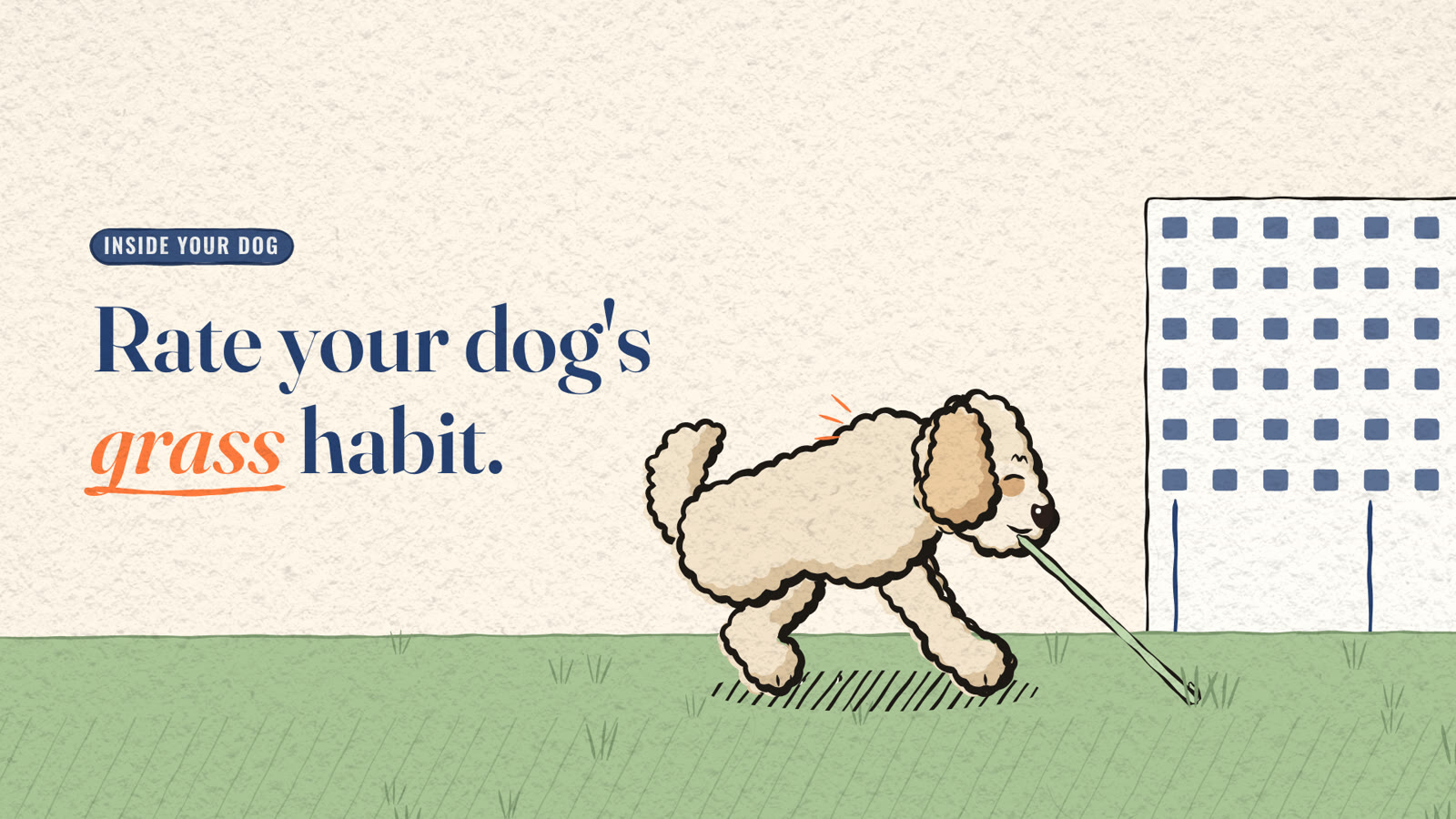
We turned the grass habit into a short film with Miya, our Goldendoodle, locked in a tug of war with one very stubborn blade on a void-deck lawn.
How do I rate my dog's grass habit from 1 to 5?
Watch what she does before, during and after. Levels one to three are everyday grass eating. Levels four and five are where you start paying closer attention.
- The sniffer. Sniffs the grass, walks off. Not her thing. Plenty of dogs rarely or never eat plants.
- The nibbler. A little nibble on most walks, then on with her day. Totally normal.
- The lawnmower. Head down, chomping away, happy as anything. She seems to just like it. Still within normal for most dogs.
- The bring-it-back. She eats it, then brings it back up now and then. Keep an eye on it and note how often it happens.
- The frantic one. Gulping grass down urgently, sick again and again, off her food. That is a vet visit.
This scale is our own way of sorting what owners see. It is not a clinical score, and your vet will look at the whole dog, not just the number.
Do dogs eat grass to make themselves sick?
Mostly not, according to the research. In the 2008 internet survey of 1,571 plant-eating dogs, only about 9% were reported to often look ill before eating plants, and 22% to regularly vomit afterwards.
Put the other way round, 92% of owners in that survey said their dog seemed normal before eating plants, and 78% said their dog did not regularly vomit afterwards. The authors tested the "she feels sick, so she eats grass to throw up" idea directly, and the data did not support it.
The careful part, because the film had to keep it short:
- These are owner reports. The numbers come from questionnaires, so they depend on what owners noticed and remembered. Owners of grass-eating dogs chose to fill the survey in.
- The headline figure varies slightly. The abstract says 9% often appeared ill first; the results section says 8%. Either way it is roughly one dog in ten.
- Sometimes the link is real. Dogs that did look ill beforehand were more likely to vomit afterwards. The authors suggest tummy discomfort may sometimes prompt plant eating, and that grass may irritate the stomach enough to cause vomiting in some dogs.
- Age mattered. Younger dogs ate plants more often and were less likely to seem ill or vomit. Older dogs were more likely to show both.
So a dog who occasionally brings grass back up is not unusual. A dog who keeps doing it is worth a closer look.
So why do dogs eat grass?
Nobody knows for certain. The leading ideas are an instinct inherited from wild ancestors and simple taste, and both are hypotheses, not proven facts. A missing nutrient looks unlikely: the 2008 study found no link between the type of diet and how often dogs ate plants, and dogs whose meals already included vegetables or fruit still ate grass.
The authors were clear that a detailed study of specific nutrients such as fibre, vitamins or minerals is still needed. The American Kennel Club (AKC) mentions extra fibre as one possible reason, and notes that extreme grass eating can be a form of pica (eating non-food things), which is worth raising with your vet.
What about the "old instinct" idea from the film? The study points out that plant remains, often grass, turn up in the droppings of wild wolves. The authors suggest plant eating may have been kept through evolution, possibly because it helped ancestral canids pass intestinal worms. That is an interesting hypothesis, not a proven fact, which is why the film says "probably". The AKC also lists simple taste (dogs may enjoy fresh new growth) and boredom as likely reasons.
How do I keep my grass-loving dog safe?
Grass itself is usually not the problem; what is on it, and what grows beside it, can be. Skip lawns that may have been sprayed, skip plants you don't recognise, keep her away from droppings, and give her other things to do.
- Sprayed grass. The AKC warns that grass treated with herbicides and pesticides can be toxic to dogs.
- Toxic plants. Some plants are poisonous to dogs. The ASPCA Animal Poison Control Center keeps a searchable list of toxic and non-toxic plants with a "toxic to dogs" filter, though it says the list is not complete.
- Parasites. The AKC notes that grass can carry intestinal parasites such as roundworms and hookworms from other animals' droppings. Keeping up with your vet's deworming advice matters here.
The Singapore angle: void-deck lawns, park edges and condo gardens are shared spaces looked after by someone else, and you usually can't tell what they were treated with or when. We could not find a public schedule for when estate or park grass is treated, so we won't guess. The simple rule is to steer her towards grass you know about, avoid patches you think were recently treated, and never let her graze on ornamental plants in planters and gardens you can't name. If you think she has eaten something toxic, call your vet straight away.
You don't need to stop a normal nibbler. If the habit bothers you, a few small changes help:
- Give her a job. The AKC suggests boredom can drive grazing. A sniffy walk, a training game or our indoor games to tire out your dog can help on rainy or hot days.
- Ask for a "leave it". Reward her for walking past the unknown planter or the sprayed verge.
- Bring water. On a humid Singapore walk she may be thirsty, and the AKC notes thirst as one reason dogs pick at fresh grass.
- Keep meals regular. The AKC suggests small meals, especially morning and night, for dogs who bring up yellow bile on an empty stomach.
- Keep treats simple. For dogs with tender tummies, single-ingredient treats are easier to keep track of. See our guide to the best treats for dogs with sensitive stomachs or browse the sensitive stomach collection.
When should I take my dog to the vet for eating grass?
Book a vet visit if she vomits repeatedly, goes off her food, seems tired or flat, eats grass frantically or more and more, or shows other symptoms alongside the grazing. Call immediately if there is blood in the vomit.
The AKC says frequent vomiting should be checked by a vet, and so should grass eating that is increasing or comes with vomiting, diarrhoea, weight loss, reduced appetite, bloody stool, lethargy or lip licking. The PDSA says a healthy dog who vomits once and seems fine may not need the vet immediately, but to call if she keeps vomiting, doesn't seem right after 24 hours or gets worse.
| What you see | Usually normal | Worth a vet check |
|---|---|---|
| How she eats it | Calm nibbling or happy grazing | Frantic, urgent gulping |
| How often | Now and then on walks | More and more, or every chance she gets |
| Afterwards | Carries on as normal | Vomits again and again |
| Appetite | Eats her meals as usual | Off her food or skipping meals |
| Energy | Her usual self | Tired, flat or hiding |
| Other signs | None | Diarrhoea, blood in vomit or stool, weight loss, lip licking |
| Age | Any age, especially young dogs | An older dog with a new or changing habit |
It also helps to look at what comes out the other end. Our dog poop chart explains what stool colour and texture can tell you, and when it is time to call the vet.
Digestive Probiotics (SGD $34.80): Firmer poops, happier walks. Prebiotics, probiotics and pumpkin in a soft chew your dog thinks is a treat.
Our Digestive Probiotics soft chews combine probiotic strains, prebiotic fibre and pumpkin to support gut health and stool quality. They are for dogs only, and they are currently on pre-order, with restock expected on 7 November 2026. They support everyday gut health; they are not a treatment for vomiting or illness, so see your vet first if she is at level five or takes medication.
Bottom line
Grass eating is mostly normal. In the largest survey we found, most grass-eating dogs seemed well beforehand and did not regularly vomit afterwards, and the "she eats it to be sick" idea did not hold up. Why they do it is still a hypothesis: an old instinct, or simply the taste. Skip sprayed lawns and plants you don't know, and see your vet if she is sick again and again, off her food or gulping frantically.
Which level is your dog? Tell us the number on our socials, and if she has a sensitive tummy, start with the sensitive stomach collection.
Frequently asked questions
Is it normal for my dog to eat grass?
For most dogs, yes. A 2008 University of California, Davis study of owner surveys concluded that plant eating is a normal behaviour of domestic dogs. Most grass-eating dogs seemed well before eating plants and did not regularly vomit afterwards. A calm nibble or a happy graze on walks is usually nothing to worry about.
Do dogs eat grass to make themselves vomit?
Mostly not. In the study's survey of 1,571 plant-eating dogs, only about 9% often looked ill beforehand and 22% regularly vomited afterwards. The researchers tested the idea directly and the data did not support it. Some dogs with an upset tummy may still graze, so watch for repeated vomiting.
Should I stop my dog from eating grass?
You don't need to stop a normal nibbler, but steer her away from lawns that may have been sprayed, plants you don't recognise and patches near other dogs' droppings. If grazing seems driven by boredom, more sniffing walks, games and a reliable 'leave it' usually help. Bring water on hot walks too.
When should I worry about my dog eating grass?
See your vet if she vomits again and again, goes off her food, seems tired or flat, eats grass frantically or more and more often, or has diarrhoea, weight loss or blood in her vomit or stool. Contact your vet straight away if you think she has eaten a toxic plant.
Can probiotics help a dog who eats grass?
Probiotics are not a fix for grass eating, which is usually normal. They can support everyday gut health and stool quality. Our Digestive Probiotics soft chews are for dogs only and are on pre-order, with restock expected on 7 November 2026. A dog who keeps vomiting needs a vet, not a supplement.
Sources
This article is general information, not veterinary advice. If your pet has ongoing symptoms, see your vet.