Rate Your Dog's Begging Move: 5 Classic Techniques
By BEANS Team · Published
TL;DR
Dogs beg because it worked at least once, and occasional rewards keep it going. The five classic moves are the Stare, the Paw, the Chin Rest, the Sigh and the Drool Puddle. Check any human food is safe before sharing, keep extras under about 10% of daily calories, and reward calm instead.
- Begging is learned: a reward even now and then keeps a move going
- A 2017 study of 24 dogs found more brow raising when a person faced them; food made no difference
- Drooling at mealtimes is a normal reflex, but new or increased drooling needs a vet
- Onions, garlic, chocolate, grapes, xylitol and salty foods are on the ASPCA's avoid list
- Feed first, use a mat, ignore every move as a household, and reward calm away from the table
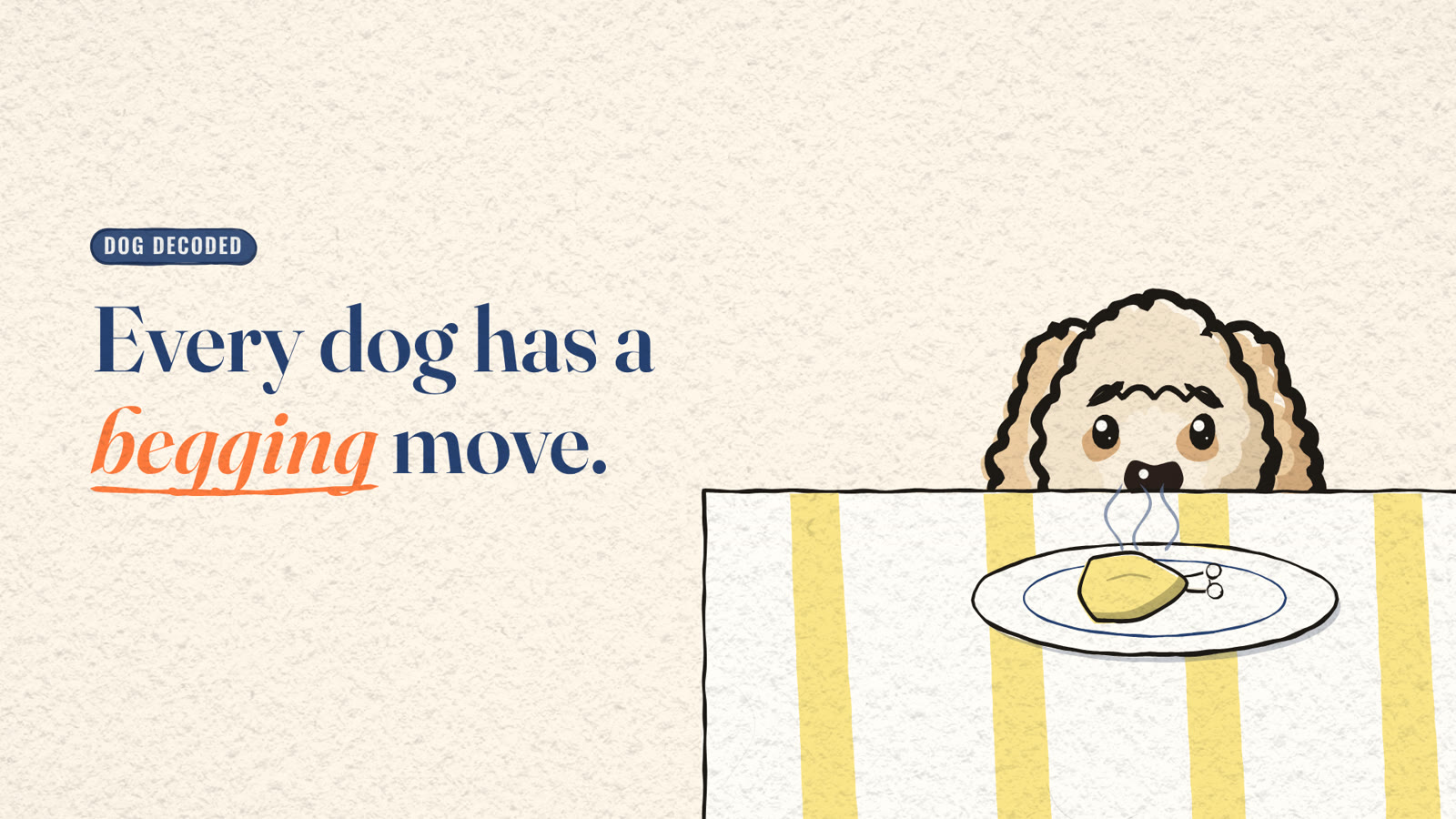
Every dog has a begging move. Here are five classic techniques, rated for fun by how well they work on you, with what each can mean and how to answer it without building a habit you will regret.
Why does my dog beg at the table?
Dogs beg because, at some point, it worked. One chip dropped from a plate, one time, is enough to teach a dog that the table is worth watching.
The AKC puts it plainly: giving food to a begging dog "is essentially teaching your dog that if she asks you for food, you'll give it to her." Even scolding can keep it going, because it "simply gives them negative attention", and attention is a reward too.
A quick word on what follows. The five moves and their paw ratings come from our short film and everyday behaviour lore, not from a study. The science sits underneath: how learning works, what a dog's face does when you look at them, and which foods are not safe to share.
Want to watch the five begging moves in 81 seconds?
We turned the five classic moves into a short film with Miya, from the Stare to the professional. Watch it, then rate your own dog below.
How do the five classic begging moves rate?
Rated by how well they work on the average human, the Drool Puddle wins and the Stare comes last. The ratings are ours and entirely unscientific, but the responses in the last column are the sensible ones.
| Move | Rating | What it can mean | How to respond |
|---|---|---|---|
| The Stare | 2 paws | An attention bid: they are waiting for you to look back | Don't make eye contact or talk to them at the table |
| The Paw | 3 paws | They have learned that touching you gets a reaction | Stay still and quiet; reward four paws on the floor later |
| The Chin Rest | 4 paws | Close contact plus lifted brows, aimed at your attention | Send them to a mat before you sit down |
| The Sigh | 3 paws | Giving up, theatrically, while still watching | Ignore it; reward the calm once the meal is over |
| The Drool Puddle | 5 paws | Not a trick: their body getting ready for food | Feed them first and keep them away from the table |
Most dogs mix and match. Every move gets stronger if it is paid, even only now and then.
What is really behind the Stare, the Paw and the Sigh?
They are all ways of asking for your attention, and each one sticks around because it has been rewarded at some point. None of them means your dog is underfed or unhappy.
The Stare (2 paws). Unblinking and patient. The idea in the film is that the moment you look back, you are negotiating. That is lore, but it fits how trainers describe begging: any response counts. The AKC says "any attention at the table will give your dog a reason to keep trying."
The Paw (3 paws). A gentle tap on the knee. Dogs learn quickly that a paw on a person gets a reaction, whether that is a stroke, a word or a crust. Each reaction makes the next tap more likely.
The Sigh (3 paws). A big, tragic flop to the floor, with eyes still open. It looks like resignation, but the dog is usually still watching your plate. If the flop is followed by a scrap "because they gave up so nicely", you have just taught the flop.
The reason all three persist so well is the way they are paid. Veterinary behaviourist Dr Valarie Tynes calls intermittent reinforcement "one of the most powerful forms of reinforcement there is." A dog who is rewarded only sometimes "never knows when or if it will be rewarded", so they keep trying. One crust a week can keep a begging habit alive.
Is the Chin Rest face really aimed at you?
Partly, yes. In a 2017 study, dogs made more facial movements, especially raising their inner brows, when a person was facing them than when the person turned away.
The study, by Juliane Kaminski and colleagues, was published in Scientific Reports. Twenty-four family dogs were leashed about a metre from a researcher, who either faced them or turned her back, and either showed food or did not. The inner-brow raise was the strongest effect: dogs did it far more when the person was paying attention. The surprising part for a begging post is that showing food made no difference to their faces. It was your attention, not the food, that changed the expression.
To be the careful version of the film:
- It was a small study: 24 dogs, in one quiet room, with a researcher rather than their owner.
- It did not test a dinner table, a lap or a begging dog.
- The authors say they cannot tell whether the dogs were deliberately communicating or giving a learned or hardwired response to seeing a face.
So "dogs make that face more when you're looking at them" is fair. "Your dog knows exactly what that face does to you" goes further than the evidence. We cover the eyebrow muscle itself in 5 ways your dog says "I love you".
Why does my dog drool when I eat?
Because their body is getting ready for food. Drooling in anticipation of something tasty is a normal reflex, not a trick, which is why the Drool Puddle earns five paws.
The AKC notes that "even dogs that don't slobber all the time can drip a bit of drool when they're anticipating something delicious." Drooling only at mealtimes is usually nothing to worry about. The AKC says to talk to your vet "immediately about any new or increased drooling", and to watch for changes in appetite or behaviour, retching, or saliva that smells bad, looks thicker or has blood in it.
Which human foods are unsafe, and how much is too much?
Some of our food is not safe for dogs, so check before you share, and keep all extras under about 10% of daily calories. The ASPCA lists chocolate, grapes and raisins, onions, garlic and chives, xylitol, macadamia nuts, alcohol, raw dough and very salty foods among the people foods to avoid.
Several hide in everyday Singapore meals. Hawker centre or kopitiam takeaway often comes with garlic, shallots, spring onion, rich sauces or plenty of salt. Sugar-free gum, sweets and some baked goods can contain xylitol, which the ASPCA says can cause low blood sugar and liver damage. It also warns that raw bones can injure or block the digestive tract.
Fatty scraps matter even when nothing on the plate is toxic. Kansas State University's Veterinary Health Center says table scraps "are high in calories and fat, lead to weight gain and can also cause gastrointestinal upset", and can trigger "life-threatening pancreatitis." VCA adds that obesity "shortens a dog's lifespan anywhere from 6 months to 2 years" and raises the risk of diabetes, arthritis and other chronic conditions.
If your dog eats something on the ASPCA list, note what and how much, and call your vet straight away.
On quantity, the UC Davis veterinary nutrition service says treats and extra foods should not exceed 10% of daily calories, with the rest from a complete and balanced diet. If your dog eats 100 Calories a day, no more than 10 should come from treats or other foods. VCA and Kansas State give the same guide. For a small dog in an HDB flat, that is not much: a few dropped chips and a chew can use it up. Ask your vet for your dog's daily figure if they are a puppy, a senior or carrying extra weight.
How do I stop my dog begging without being mean?
Stop paying for it, everyone at once, and give your dog something better to do. Expect it to get worse for a while before it gets better.
- Feed your dog first. The AKC suggests feeding them just before your meal, ideally in another room.
- Give them a spot. A mat, bed or crate near the table, with a cue such as "go to your spot". In an open-plan HDB flat where the dining table is part of the living room, a baby gate or a mat across the room does the same job.
- Ignore every move. No eye contact, no talking, no "just one". Scolding counts as attention too.
- Get the whole household on board. Dr Tynes says "all family members need to be in agreement" for this to work. That includes grandparents, kids, helpers and visitors who think one crust won't hurt.
- Ride out the burst. The AKC warns behaviour "may get worse before it gets better": when a ploy stops working, dogs "try harder before they eventually give up." Giving in at the loudest moment teaches the loudest move.
- Reward the calm alternative. When your dog is lying quietly on their mat, walk over and drop a tiny reward there, never from your plate.
Turkey Freeze-Dried Pet Treats (SGD $13.90): Pure turkey. Nothing else. Lean white meat that's gentle on the stomach and great for training.
A crumb of single-ingredient turkey works well as a mat reward. It is one protein with nothing added, and you can break each piece very small so it counts for little in the day's 10%. If your dog has a sensitive tummy, our guide to treats for sensitive stomachs covers what to look for, and for burning off energy before dinner, try 5 games to tire out your dog indoors.
If your dog suddenly begs far more than usual, or seems hungry all the time, mention it to your vet. Changes in appetite can have medical causes.
Bottom line
Every begging move works because, at some point, someone taught it. Rate your dog's for fun, keep human food off the menu unless you have checked it is safe, keep extras under about 10% of the day, and reward the quiet dog on the mat instead of the one under your chair.
What's your dog's move? Tell us on our socials.
Frequently asked questions
Why does my dog beg for food?
Because it has worked before. A single dropped chip or crust teaches a dog that the table pays off, and rewards that come only sometimes make the habit especially stubborn. Veterinary behaviourist Dr Valarie Tynes calls intermittent reinforcement one of the most powerful forms of reinforcement there is.
Do dogs make puppy eyes on purpose?
Partly. A 2017 Scientific Reports study found dogs raised their inner brows more when a person faced them, and showing food made no difference. It was small, with 24 dogs in one room, and the authors could not say whether the dogs were deliberately communicating or responding automatically to a face.
Why does my dog drool when I eat?
Their body is getting ready for food. The AKC notes that even dogs who rarely slobber can drip a bit of drool when anticipating something delicious. Drooling only at mealtimes is usually normal, but talk to your vet about any new or increased drooling, or drooling with retching or appetite changes.
What human food is dangerous for dogs?
The ASPCA lists chocolate, grapes and raisins, onions, garlic and chives, xylitol, macadamia nuts, alcohol, raw dough and very salty foods. Fatty scraps can cause stomach upset and even pancreatitis. Hawker takeaway often contains garlic, shallots and salt, so check before sharing and call your vet if your dog eats something risky.
How do I stop my dog begging at the table?
Feed your dog first, send them to a mat or behind a gate, and have everyone in the household ignore every move, every time. Expect begging to get worse briefly before it fades. Reward your dog with a tiny treat on the mat when they are calm, never from your plate.
Sources
- Kaminski et al. (2017), Human attention affects facial expressions in domestic dogs, Scientific Reports 7:12914
- ASPCA: People foods to avoid feeding your pets
- AKC: How to stop your dog from begging at the table
- AKC: Dog begging at Thanksgiving
- dvm360, Valarie Tynes DVM DACVB: How do I help clients keep their dogs from begging?
- UC Davis Veterinary Medical Teaching Hospital, Nutrition Support Service: Treat guidelines for dogs
- Kansas State University: Pet holiday weight gain and table scraps
- VCA Animal Hospitals: Health risks for obese dogs
- AKC: Dog drooling, when is it cause for concern?
This article is general information, not veterinary advice. If your pet has ongoing symptoms, see your vet.