Why Do Dogs Drink Water So Messily? She Drinks Backwards
By BEANS Team · Published
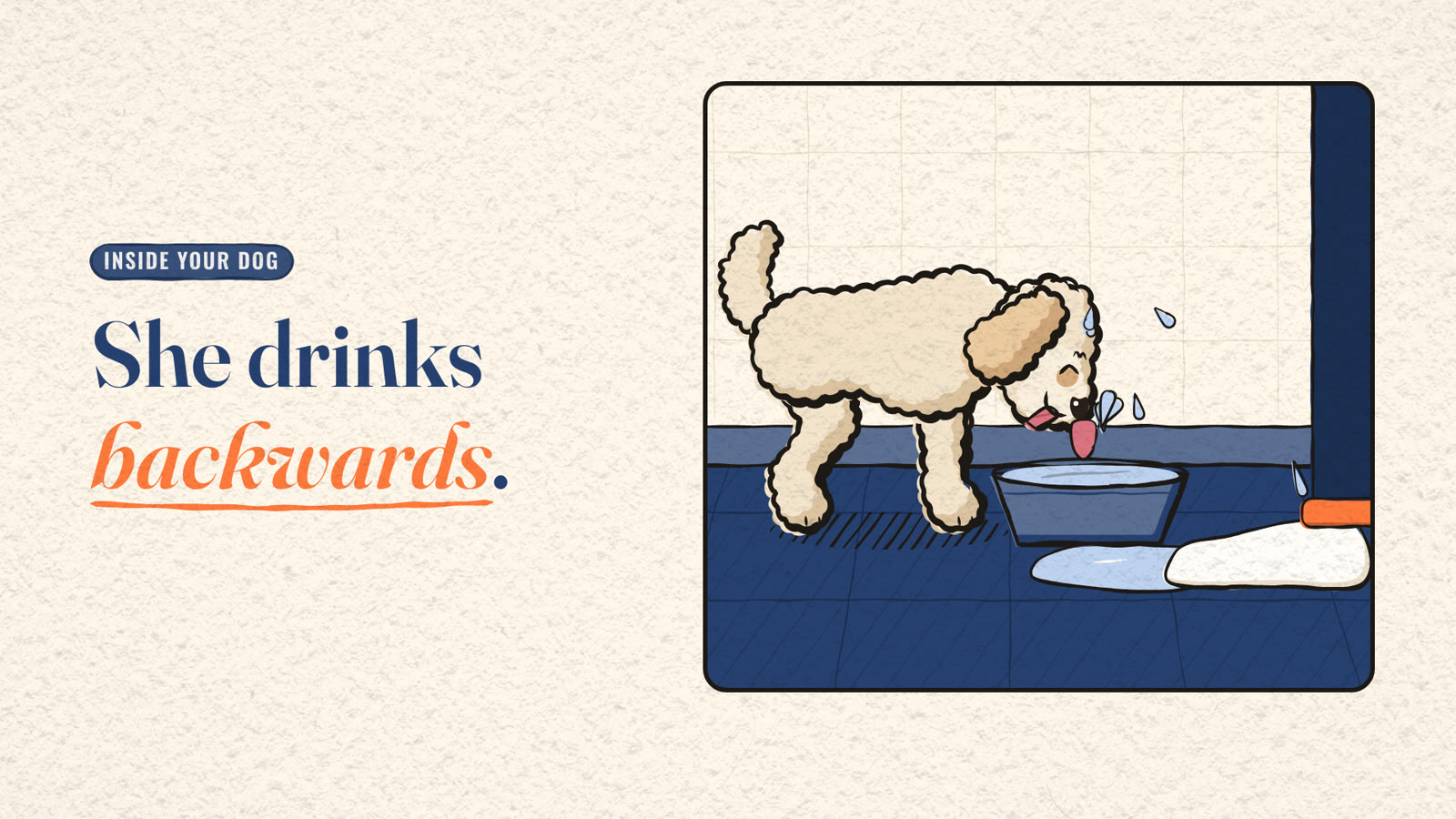
TL;DR
Dogs drink messily because their incomplete cheeks cannot seal, so they cannot suck. They curl the tongue backwards, whip it up to pull a column of water, and bite it off, while most of the scoop spills. Track her intake with a bowl line, never restrict water, and see your vet if thirst rises.
- Dogs cannot suck water because their cheeks are incomplete, so they lap with the tongue curled backwards like a ladle
- A fast upward whip of about 1 to 4 g pulls up a column of water, and the dog bites it off; most of the ladle spills out
- The study filmed only 19 dogs and parts of the explanation are still hypotheses, so treat the numbers as estimates
- A bowl line (fill to the same mark each morning, check at night) helps you learn her normal; healthy dogs drink about 40 to 60 ml/kg a day
- Drinking and peeing much more than her normal is worth a vet check, and you should never take her water away
You top up her bowl, she trots over, and thirty seconds later there is a puddle on the kitchen floor, a wet chin on your knee and, if you are unlucky, a damp sock. It looks careless. It is actually physics. Here is what the research shows, what it does not show, and the one bowl habit that turns all that splashing into something useful: knowing how much your dog really drinks.
Why does my dog make such a mess when she drinks?
Because she cannot suck. Dogs have incomplete cheeks, so they cannot seal their mouth and pull water up the way we do through a straw or a cup. They lap instead, and lapping flings water out of the bowl.
That is the starting point of a 2015 study in the journal PNAS by Sean Gart, Jake Socha, Pavlos Vlachos and Sunghwan Jung at Virginia Tech, titled "Dogs lap using acceleration-driven open pumping". In the authors' words, dogs "lap because they have incomplete cheeks and cannot suck." The drops that fly off each scoop are your puddle.
Want to watch Miya drink backwards in 72 seconds?
In our short film, Miya floods her kitchen floor, then a slow-motion replay shows the backwards tongue, the water column and the snap, before the bowl line and when to call the vet.
How does a dog's tongue actually lap up water?
The tongue curls backwards into a ladle, dips in, then whips up very fast, pulling a column of water up behind it. The dog bites down on that column at just the right moment. Here is the sequence the researchers filmed with high-speed cameras:
- The curl. Before the tongue touches the water, its tip curls backwards (towards the chin) into what the paper calls a "ladle" shape.
- The dip. The curled tongue plunges into the water.
- The whip. The tongue pulls back up with accelerations of about 1 to 4 times gravity (1 to 4 g). The paper describes a small dog at around 2 g and a large dog at around 4 g, which is where the film's "up to four times gravity" comes from.
- The column. That fast pull drags a column of water up out of the bowl, a little like pulling your finger quickly out of a glass.
- The snap. The dog closes her jaws at about the moment the column would pinch off and fall back, and that bite is what gets the water in.
- The spill. Earlier X-ray work, cited in the paper, showed that most of the water scooped in the ladle falls back off the tongue. Only the water on top of the tongue goes in.
So the "ladle" is not the main way water gets in. The column is. The ladle mainly carries water up and drops most of it, and the paper suggests the curl may help make a bigger column. Each lap only brings in a small amount: the authors use a figure of about 2.5 ml per lap. That is why a thirsty dog laps over and over, and why the floor gets wet.
What does the research not tell us?
The mechanics are well filmed, but the study is small and some of it is still a hypothesis. The film is the friendly version; here are the caveats it had no room for.
- It is 19 dogs. The team filmed 19 dogs, mixed and purebred, from a 5 kg Yorkshire terrier mix to a 64 kg Great Dane. That is a good spread of sizes but a small sample.
- "Up to 4 g" is a range, not a rule. Accelerations ran from about 1 to 4 g. The paper found no clear link between acceleration and body weight, so a big dog is not guaranteed to whip faster than a small one.
- Why the tongue curls is a suggestion. The authors say their data "suggests" the curl creates a larger column, and that the role of scooping "should be investigated further".
- The physics model used glass rods. To test the idea, they pulled rigid rods out of water, not real tongues, and they note that surface tension and the volume scaling are not fully explained.
- The "most of it falls out" finding comes from earlier X-ray studies that the paper cites, not from this team's own filming.
The big picture holds: dogs cannot suck, and the mess is a side effect of lapping. Treat the exact numbers as estimates.
How do you know how much your dog really drinks?
You cannot tell by looking, because so much ends up on the floor. A simple bowl line helps: fill to the same mark every morning, check the level at night, and learn her normal over a few days.
The Cornell Riney Canine Health Center notes that most owners do not measure their dog's water intake and only have a rough idea from how often they refill the bowl. The American Kennel Club (AKC) suggests keeping a note of your dog's drinking habits so you can spot anything out of the ordinary. The bowl line is our simple way to do that:
- Pick a line. Use a mark inside the bowl, or a strip of tape on the outside.
- Every morning, fill her bowl to the line.
- At night, see how far the level has dropped.
- Do it for a few days to learn her normal range, then keep an eye out for big changes.
If you want a number, use a measuring jug instead of a line: note what goes in, top up from the jug, and pour off what is left the next morning. Both Cornell and the AKC put normal intake at roughly 40 to 60 ml per kilogram of body weight a day, and Dr Brian Collins of Cornell says drinking more than 100 ml/kg a day is generally considered excessive (polydipsia).
| Dog's weight | Typical daily water (40 to 60 ml/kg) | Generally considered too much (over 100 ml/kg) |
|---|---|---|
| 5 kg | 200 to 300 ml | over 500 ml |
| 10 kg | 400 to 600 ml | over 1 litre |
| 20 kg | 800 to 1,200 ml | over 2 litres |
| 30 kg | 1.2 to 1.8 litres | over 3 litres |
A few honest limits of any bowl method: the puddle on the floor counts as "drunk", other pets sharing the bowl will skew it, and water from wet food or other bowls is not included. That is why it is better at spotting a change from her own normal than at giving an exact figure.
When is extra drinking normal, and when should you see a vet?
More drinking after a hot day or a long walk is normal. Drinking much more than her normal, day after day, especially if she is also peeing more, is worth a vet check.
The AKC says it is normal for dogs to be thirstier in hot weather and after exercise, and that intake shifts with activity and diet. In Singapore that means the bowl line will often drop further on a sticky afternoon or after a long weekend walk. Early morning or evening walks, and a full bowl when you get home, are sensible habits; our sniff walk guide has a gentler way to tire her out, and during haze season our haze guide covers keeping water topped up indoors.
The AKC also says that a dog regularly drinking a lot of water "can be one of the earliest clues" of an underlying health problem. Cornell lists possible causes of drinking and peeing more, including urinary tract infection, diabetes, kidney disease, Cushing's and Addison's disease, pyometra in unspayed females, liver disease and some cancers. The AKC adds that some medicines can increase thirst. Only your vet can tell these apart, usually with urine and blood tests.
| What you notice | Likely meaning | What to do |
|---|---|---|
| Line drops more on hot days or after a long walk | Normal | Keep fresh water available |
| One unusually thirsty day, then back to normal | Usually normal | Keep watching the line |
| Line drops much faster than her normal, day after day | Possible early clue | Book a vet check |
| Drinking more and peeing more, or accidents indoors | Possible early clue | Book a vet check |
| Drinking more plus vomiting, not eating or very tired | Could be serious | Call your vet promptly |
One thing not to do: never take her water away to "fix" it. Cornell is clear that water should not be restricted before she has been assessed, because it can lead to dehydration or dangerous electrolyte problems. Bring your bowl-line notes to the appointment, and talk to your vet about what they mean for your dog.
Can you make your dog a tidier drinker?
Not really, because the splash is built into how she drinks, but you can contain it. Put the bowl on a washable mat or an easy-to-wipe tile, away from where people walk in socks, and wipe up puddles on smooth floors so nobody slips. A heavier bowl that does not slide around can help too.
After a hot walk, give fresh water first, then a small reward once she has settled. Small, single-ingredient treats are easy to keep track of; our guide to how many treats a dog should have explains how to keep rewards within her daily allowance.
Turkey Freeze-Dried Pet Treats (SGD $14.90): Pure turkey. Nothing else. Lean white meat that's gentle on the stomach and great for training.
Our Turkey freeze-dried treats are 100% turkey and break into small pieces, so one cube goes a long way. The full single-ingredient range is in our freeze-dried treats.
Bottom line
Your dog is not a messy drinker by choice. With incomplete cheeks she cannot suck, so she curls her tongue backwards, whips it up to pull a column of water, and snaps her jaws shut on it, while most of the scoop splashes out. The research is a small study of 19 dogs and parts of it are still hypotheses, but the picture is clear. Use a bowl line to learn her normal, expect more on hot days, never take her water away, and book a vet check if she is drinking and peeing much more than usual.
For post-walk rewards, try our Turkey freeze-dried treats. They ship within Singapore, within 24 hours. First order? Use code TRY25NOW for 25% off orders of $25 or more (up to $10 off).
So, is yours a splasher or a sipper?
Frequently asked questions
Why does my dog spill so much water when drinking?
Dogs cannot suck because their cheeks do not seal, so they lap. The tongue curls backwards, dips, and whips up fast enough to pull a column of water into the mouth. Most of the water scooped on the curled tongue falls back out, and the fast movement flicks drops over the floor.
Do dogs really drink backwards?
In a sense. A 2015 PNAS study filmed dogs curling the tip of the tongue backwards, towards the chin, into a ladle shape before it hits the water. The tongue then pulls up quickly, drawing a column of water behind it, and the dog bites down on the column to swallow it.
How much water should my dog drink a day?
Cornell and the AKC say healthy dogs drink roughly 40 to 60 ml per kilogram of body weight a day, so a 10 kg dog drinks about 400 to 600 ml. Heat, exercise and diet change it. More than 100 ml per kilogram a day is generally considered excessive and worth discussing with your vet.
When should I worry about my dog drinking a lot of water?
Worry when she drinks much more than her normal day after day, especially if she is also peeing more or having accidents. The AKC calls heavy drinking one of the earliest clues of illness such as kidney disease or diabetes. Book a vet check, and call promptly if she is also vomiting or very tired.
Should I limit my dog's water if she drinks too much?
No. Cornell's Riney Canine Health Center advises against restricting water before a vet has assessed her, because it can cause dehydration or dangerous electrolyte problems. Keep fresh water available, note how much she drinks with a bowl line or measuring jug, and take those notes to your vet.
Sources
This article is general information, not veterinary advice. If your pet has ongoing symptoms, see your vet.