How Many Treats Should a Dog Have a Day? The Treat Jar Trick
By BEANS Team · Published
TL;DR
Treats should make up less than 10% of your dog's daily calories, about 47 kcal for an average 10 kg dog. Chews, table scraps, training rewards and pill cheese all count. The easy fix: fill one small jar with the day's treats each morning, break every treat into small pieces, and trim dinner slightly on big treat days.
- WSAVA: treats should make up less than 10% of a dog's daily calories
- The 10% is calories, not the number of treats, so small pieces go further
- Chews, table scraps, supplements and food used to give pills all count as treats
- One digestive biscuit (75 kcal) is more than a 10 kg dog's whole daily treat allowance (47 kcal)
- The treat jar trick: fill one small jar each morning, go small, and trim dinner a little on big treat days
A biscuit at breakfast, the crust off your toast, a few treats on the walk, cheese round a pill and whatever the kids drop at dinner. None of it feels like much, and that is exactly the problem. Here is how many treats a dog should have, why the small extras matter more than the big ones, and the treat jar trick that keeps a whole household on track.
How many treats should a dog have a day?
Treats should make up less than 10% of your dog's daily calories. For an average 10 kg adult dog that is about 47 kcal a day, so the honest answer is "fewer than you think", and the number of treats depends on how many calories each one carries.
The WSAVA (the World Small Animal Veterinary Association) puts it plainly in its 2024 owner handout: "Treats should always make up less than 10% of a dog's daily calorie intake." The AKC adds the part people miss: "The 10% refers to calories consumed, not volume or number of treats." So ten tiny pieces can be fine and one big chew can blow the whole day.
The 10% guide exists for two reasons, both in the WSAVA handout: too many treats can "unbalance the main diet" and "contribute to unintended weight gain." Treats aren't complete food, so the other 90% has to do the nutritional work.
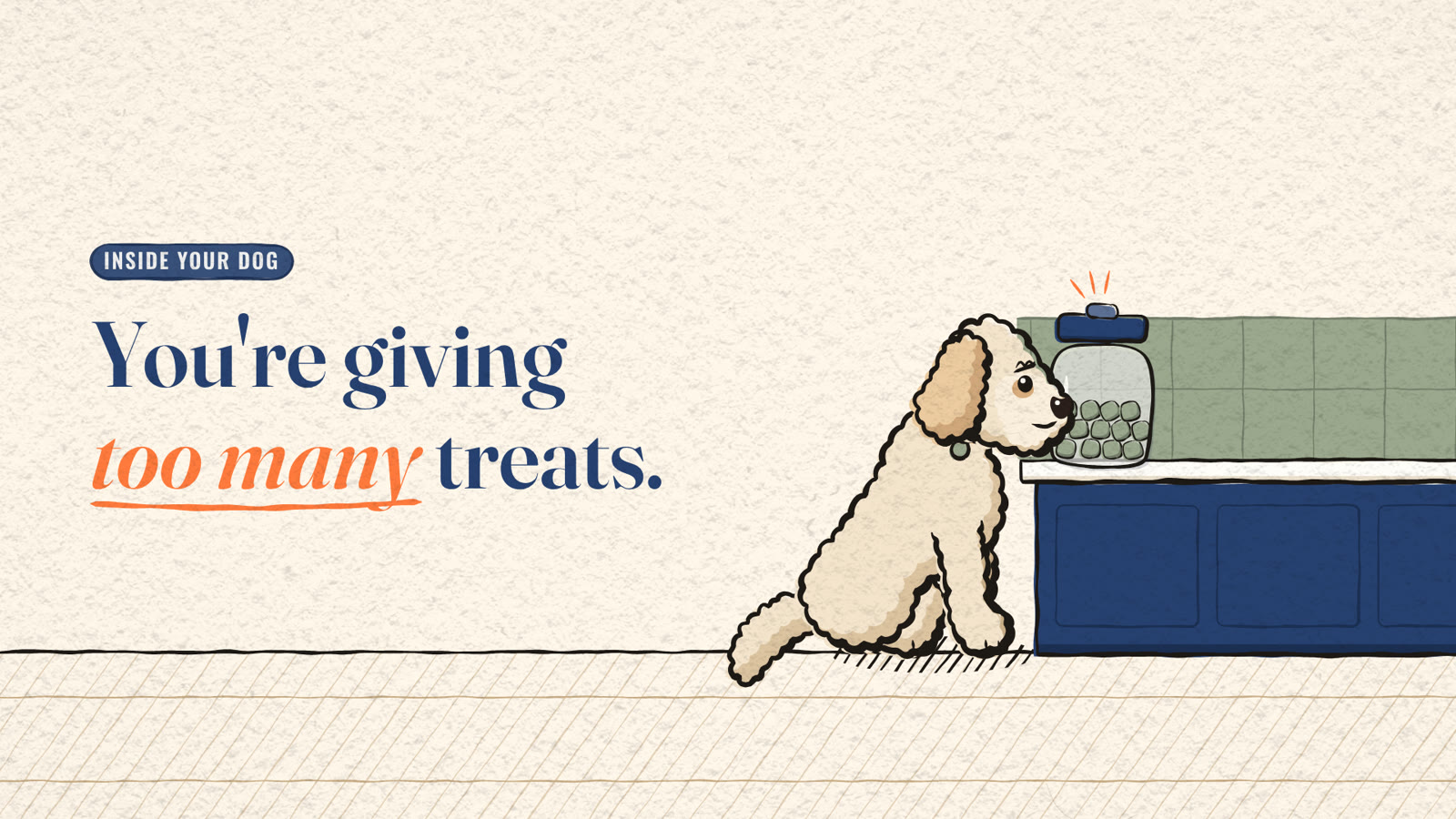
Want to watch the treat jar trick in 67 seconds?
Our Inside Your Dog film follows Miya through one ordinary day of snacks, shows where it all adds up, and ends with the three fixes.
What counts as a treat?
Everything your dog eats that isn't her complete, balanced meal. That includes chews, table scraps, training rewards, supplement chews and the cheese you hide a pill in.
WSAVA's definition is broad on purpose: treats are "any food items that are given to your dog in addition to a complete and balanced diet," including "snacks, chews, supplements, and foods used to administer medication," whether bought or made from food meant for people. The AKC's list covers "meals, snacks, training treats, and table scraps", and says treats should fit within the daily allowance, "not be added on top of it."
The usual blind spots:
- Pill cheese and peanut butter. A tablespoon of peanut butter is 81 kcal in WSAVA's table, more than a whole day's treat allowance for a 15 kg dog.
- Chews. Long-lasting chews are often the densest thing your dog eats all day.
- Scraps from other people. The crust, the bit of chicken rice, the piece dropped under the high chair.
- Training rewards. Lots of small rewards still add up over a training session.
Why is it the small extras, not the big treats?
Because nobody counts them. A single human snack can use a small dog's whole allowance, and when several people each give "just one", the day quietly doubles up.
WSAVA's table shows the scale. These are its calorie figures, set against the daily treat allowance for a 10 kg dog (47 kcal) and a 4 kg dog (24 kcal), both from the same handout:
| Snack (WSAVA figures) | Calories | Share of a 10 kg dog's treat allowance | Share of a 4 kg dog's treat allowance |
|---|---|---|---|
| Ham, 28 g | 46 kcal | about 100% | nearly 200% |
| Lean cooked chicken breast, 28 g | 47 kcal | 100% | nearly 200% |
| One digestive biscuit, 17 g | 75 kcal | about 160% | about 310% |
| Peanut butter, 1 tbsp | 81 kcal | about 170% | about 340% |
| Cheddar cheese, 28 g | 120 kcal | about 255% | 500% |
| Tripe stick, 28 g | 217 kcal | about 460% | about 900% |
WSAVA's own note on that table: "For some dogs, consuming just one of these in the specified quantity could exceed their maximum recommended daily calorie intake from treats."
There is also a gap between what we think and what we do. In a University of Guelph study summarised by its pet nutrition team, dog and cat caregivers estimated that treats made up about 15% of their pet's diet, by quantity. That isn't the same measure as calories, so it doesn't prove those pets were over the 10% line, but it hints that many of us are giving more than the guideline allows. The same team noted caregivers often fed human food and table scraps "on a frequent basis."
How do I work out my own dog's treat allowance?
Take your dog's daily calories and divide by ten. WSAVA's table gives a starting point by weight, and your vet can give you a figure for your own dog.
| Dog's weight | Daily calories from treats (WSAVA) |
|---|---|
| 2 kg | 14 kcal |
| 4 kg | 24 kcal |
| 6 kg | 32 kcal |
| 10 kg | 47 kcal |
| 20 kg | 79 kcal |
| 30 kg | 108 kcal |
| 40 kg | 134 kcal |
These figures are based on an average healthy adult dog at an ideal weight. Puppies, very active dogs, older dogs and dogs who need to lose weight are different, so treat it as a ballpark. WSAVA's advice is to ask the manufacturer for calorie information if it isn't on the label, and to "chat with your dog's veterinary health care team to determine a suitable quantity and type of treat."
What is the treat jar trick?
Three habits: fill one small jar with the day's treats each morning, break each treat into small pieces, and trim dinner a little on a big treat day. None of them means saying no all day.
1. The treat jar. Each morning, put the day's treats in one small jar. Everyone in the house uses it, and when it's empty, it's empty. It turns the 10% guide into something you can see, and it solves the "I only gave her one" problem when four people each gave one. In many Singapore homes the dog is fed by more than one person, grandparents or a helper included, so a shared jar on the kitchen counter beats trying to keep everyone's tally in your head. Pill-time cheese comes out of the jar's budget too.
2. Go small. Snap each treat into little pieces, so one treat makes four rewards. Dogs work happily for a tiny piece, and the AKC's point stands: it's the calories that count, not the number of rewards. WSAVA also asks that any treat is "an appropriate size and shape to reduce the risk of choking", so small and soft beats big and hard.
3. The swap. Big treat day, such as a birthday chew or a long training session? Take a little out of her dinner. The AKC says to "slightly reduce your dog's regular meal portions to keep their calorie intake consistent", with a clear limit: "avoid cutting too much from their main food."
| Habit | What it fixes | Watch out for |
|---|---|---|
| The treat jar | Several people each giving "just one" | Count chews and pill food from the jar too |
| Go small | One treat used as one big reward | Pick treats that break or crumble easily |
| The swap | The occasional big chew or training day | Trim a little, never swap a meal for treats |
Is it fine to swap a meal for treats?
No. Swapping a little is fine on the odd day, but treats should never replace a meal. WSAVA says so directly: "every dog needs a complete and balanced diet."
The careful version: a 2025 modelling study in Veterinary Sciences tested what happens when treats make up 10% of the day's energy and the main food is cut to make room. For dogs the news was good: every diet it modelled still met the protein and fat minimums. The shortfalls turned up in cats. The authors still caution that cutting the main food "may imply a reduced intake of essential nutrients", and the study only looked at protein and fat, using label figures rather than real pets. So the 10% guide holds up for dogs, as long as the swap stays small and the main meal keeps doing its job.
Some dogs shouldn't have ordinary treats at all. WSAVA notes that dogs with a medical condition, food sensitivities or a prescription diet may need different rules, so ask your vet first. If your dog is on a food trial, read our elimination diet guide before giving anything.
Which treats make the treat jar easy?
Small, plain treats that break into tiny pieces. Single-ingredient treats help because you know exactly what's inside, and freeze-dried ones crumble small without a knife.
Rabbit Freeze-Dried Pet Treats (SGD $15.90): Pure rabbit. Nothing else. A classic novel protein, lean and gently digestible.
Our Rabbit Freeze-Dried Pet Treats are 100% rabbit and nothing else, and one cube snaps into several jar-sized rewards. Check the feeding guide on the product page and count them in her 10%. They help with the jar trick, but they're still treats: they don't replace her balanced meal.
Two more ideas that cost no calories at all. The Guelph team suggests rewards that don't involve food, like play, and enrichment feeders such as food puzzles to make portions last. Our indoor games guide has plenty for wet or hot afternoons. And if the extras mostly happen at the dinner table, our begging moves guide covers how to stop the habit without the drama.
Bottom line
Keep treats under 10% of your dog's daily calories, and count everything: chews, scraps, pill cheese and training rewards. For most dogs that is less than it feels. Fill one small jar each morning, break every treat into little pieces, and trim dinner slightly on big treat days. Fewer treats, same love. If your dog is overweight or has a medical condition, ask your vet for her own number.
Ready to fill the jar? Browse our best-selling single-ingredient treats.
Frequently asked questions
How many treats can my dog have a day?
Enough to stay under 10% of her daily calories, which is about 47 kcal for an average 10 kg adult dog and 24 kcal for a 4 kg dog, according to WSAVA. The number of treats depends on their calories, so small pieces go much further than whole biscuits or chews.
Do table scraps and chews count as treats?
Yes. WSAVA counts snacks, chews, supplements and foods used to give medication as treats, and the AKC includes table scraps and training treats. Anything outside her complete, balanced meal counts towards the 10%, including the cheese you wrap round a pill and food the kids drop.
Should I feed less dinner if my dog had lots of treats?
A little less, yes. The AKC suggests slightly reducing regular meal portions to keep daily calories steady, but warns against cutting too much from the main food. Treats should never replace a meal, because they are not complete and balanced like her main diet.
How do I stop family members overfeeding treats?
Try a treat jar. Each morning, put the day's allowance in one small jar that everyone uses, and when it's empty, it's empty. It makes the 10% guide visible and stops several people each giving just one. Count chews and pill food from the same jar.
Are small training treats better than big ones?
For keeping calories down, usually yes. The AKC notes the 10% rule is about calories, not the number of treats, so breaking a treat into four pieces gives four rewards for the same calories. WSAVA also asks that treats are an appropriate size and shape to reduce choking risk.
Sources
- WSAVA Global Nutrition Committee: Feeding treats to your dog (owner handout, v2, 2024, PDF)
- American Kennel Club: How many treats can a dog have per day? (Anna Burke)
- Príncipe et al. 2025, Assessment of the nutritional impact of the 10% snack recommendation in pet diets (Veterinary Sciences)
- Pet Nutrition at OVC, University of Guelph: New publications, treat feeding with dogs and cats (Shelby Nielson)
This article is general information, not veterinary advice. If your pet has ongoing symptoms, see your vet.