Why Do Female Dogs Mark? Marking vs Peeing, Heat and Leg-Lifting
By BEANS Team · Published
TL;DR
Female dogs do urine-mark, though less than males. A mark is a few drops on upright spots, sent as a social message. Girls mark more around their season, and stress can trigger it. Some lift a leg. If she suddenly wees more often, strains or has indoor accidents, see your vet to rule out a UTI.
- Female dogs mark too, intact and spayed, but less often than males on average
- A mark is a few drops on many upright spots; a wee empties the bladder in one go
- Heat is the best-supported reason; the confidence link rests on thin evidence
- Some girls lift a leg: 6 percent of wees at one shelter, 19 to 37 percent in other studies
- Frequent wees, straining or new indoor accidents need a vet check for a UTI
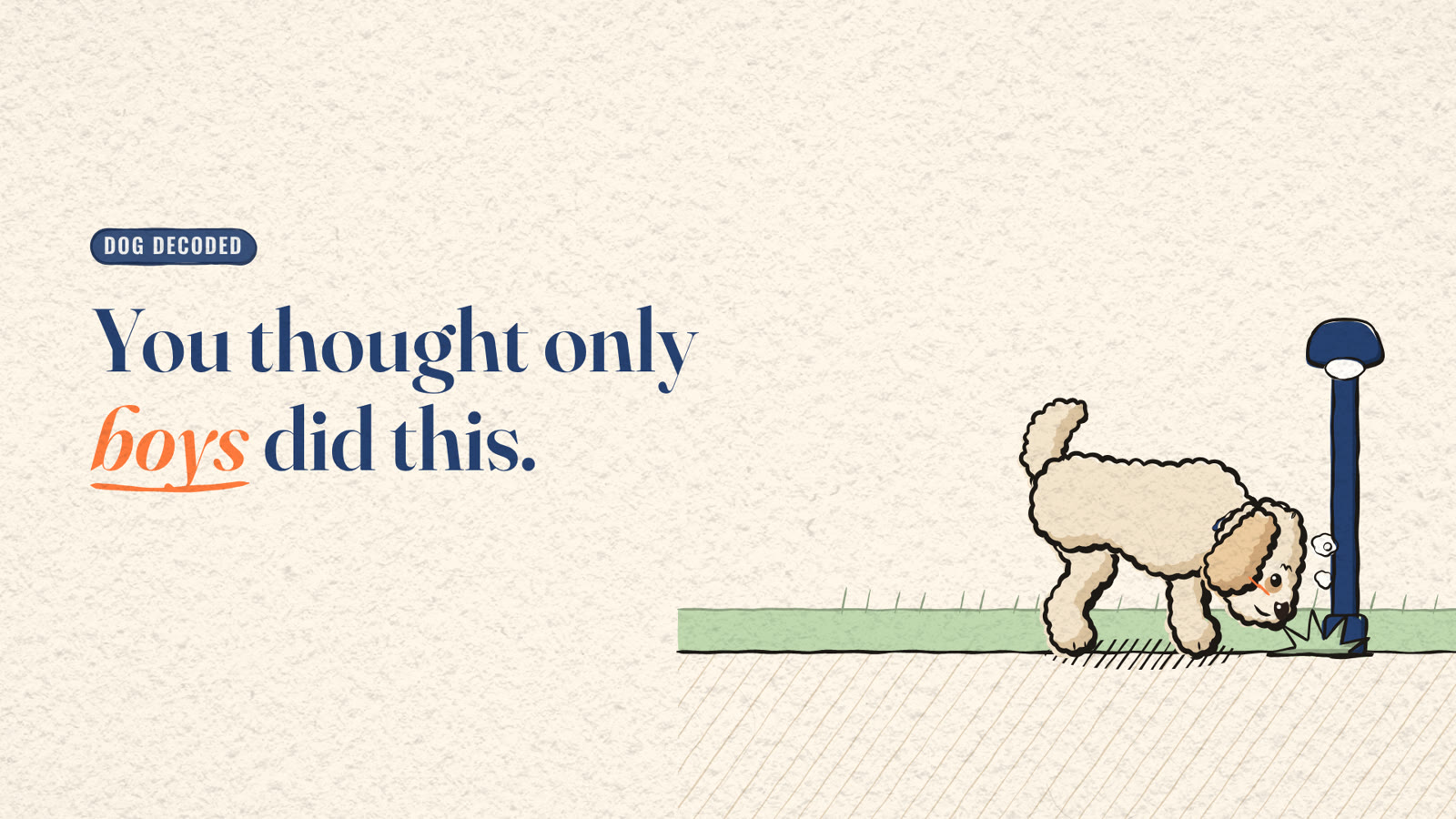
Your girl stops at every lamp post, sniffs hard, then leaves a few drops and moves on to the next one. Maybe she even lifts a leg. Plenty of owners assume only male dogs do this. They don't. Here is what the research says about why female dogs mark, how to tell it apart from a normal wee, and when it is worth a trip to the vet.
Do female dogs mark?
Yes. Female dogs urine-mark too, though on average less than males. VCA Animal Hospitals says "intact females also engage in urine marking, as well as many neutered males and spayed females," and the Merck Veterinary Manual agrees that "females (both spayed and unneutered) and neutered dogs can also mark."
Marking is most common in unneutered males, so it is the boys who get the reputation. A 2019 review of desexing research by Urfer and Kaeberlein goes further and says female dogs "do not generally show urinary marking." That line rests on a single study, though, and the authors note there is more research on male dogs than on female dogs. So the fair summary is: girls mark less often than boys, but a girl who marks is not unusual and not confused.
Want to watch why female dogs mark in 68 seconds?
Our Dog Decoded film follows Miya on a walk as she hunts for the perfect spot, then explains what her marks mean and the one sign that needs a vet.
What's the difference between marking and peeing?
A normal wee empties the bladder in one go. A mark is a few drops, left on several spots, usually on something upright. Merck describes marking as "urination or defecation that is used to send a social signal," so it is a message rather than a toilet trip.
The AKC says marking leaves "small amounts of urine in multiple locations," while a dog emptying her bladder "will leave more pee in a single spot." Its marking page adds that preferred objects "usually have a vertical surface, like a fence post or tree trunk." VCA puts it simply: "Most urine marks contain only a small volume of urine."
| Marking | A normal wee | |
|---|---|---|
| Amount | A few drops | A full bladder |
| Where | Many spots on one walk | Usually one spot |
| Favourite targets | Posts, trees, corners, anything upright | Grass, drains, the ground |
| How long | A few seconds (AKC) | Around 20 seconds in a healthy dog (AKC) |
| What it's for | A social signal to other dogs | Emptying the bladder |
| When it starts | Usually adolescence (AKC) | From puppyhood |
In an HDB estate, a girl who marks will often pick the base of a lamp post along the walkway, a void deck pillar or a planter edge. That is normal dog behaviour. It is also kind to your neighbours to carry a small bottle of water and rinse a mark on a pillar or near a lift lobby.
Why would a female dog mark?
Three reasons come up most: her heat cycle, her social confidence, and stress. Only the first is well supported for female dogs specifically, so here is each one with how strong the evidence is.
Her season (heat). The AKC says females mark "especially intact bitches in heat," and that intact females may raise a leg during heat cycles "to signal reproductive availability." A 2025 study by Quaranta and colleagues in Scientific Reports notes, from earlier research, that marking frequency increases in the proestrus and oestrus phases. Their own experiment tested only 11 male dogs, so treat that paper as background rather than proof about girls.
Confidence and status. This is the softest part of the story. A 2011 study by Lisberg and Snowdon in Animal Behaviour looked at 48 Labradors on a course of urine-marked stakes and 87 dogs at a dog park. As reported by NBC News, higher-status dogs were "far more active than other dogs at countermarking," and both sexes countermarked. We have only read the study through that news report, not the paper itself, so "confident girls can mark more" is a reasonable reading, not a settled fact.
Stress and change. VCA says "marking can be triggered by anxiety or frustration related to social or environmental changes," such as a new dog nearby. The AKC's page on female marking says that in a spayed female, "anxiety is probably underlying the behavior." A new dog at home, a move, building works next door or a new work schedule can all be triggers. If you think stress is behind it, our guide to tiring your dog out indoors has calm, low-key games that use her nose.
Do female dogs lift their leg to pee?
Some do, and more than you might expect. The AKC says "some female dogs lift their legs to pee," and that this "may depend on comfort, environment, or hormones." Merck notes that marking dogs usually lift their legs, which puts the scent higher on a post where other dogs can find it.
The numbers vary a lot by setting. McGuire and colleagues (2020, Animals) watched 100 shelter dogs on leash walks at an SPCA in New York, 43 of them female. Only 6 percent of adult females' urinations involved a raised hind leg at their shelter, compared with 19 to 37 percent "for adult female dogs living under other conditions." The 19 to 37 percent figures come from earlier studies the authors cite, not their own dogs, and none of these studies are large. So "up to about a third of wees" is the top of a range, not what every girl does. A girl who squats every time is just as normal.
Does spaying stop a female dog marking?
Maybe, but the evidence is weak. The AKC's female marking page says that if she is intact, "spaying will likely address the problem." VCA is more cautious: neutering "may reduce the tendency to mark, but it is not a guaranteed cure," and "marking occurs whether dogs are sexually intact, neutered, or spayed."
The research review by Urfer and Kaeberlein found consistent evidence that desexing reduces marking in most male dogs. For females it says urinary behaviour "is not generally affected by desexing," but that conclusion leans on one study. Spaying is a bigger health decision than marking alone, so talk it through with your vet rather than spaying just to stop marks.
How do I stop my female dog marking indoors?
Marking outdoors on walks needs no fixing. Indoors, start with a vet check, then clean well, supervise, reward the right spot and never punish. Here is what the AKC, VCA and Merck recommend.
- Rule out a medical cause first. VCA says to have your vet examine her first, and that a check-up "is particularly important if your dog was well house-trained and suddenly begins urinating indoors."
- Clean marks completely. The AKC recommends an enzymatic cleaner, then a UV light to make sure no urine was missed. Merck says to clean accidents "quickly and completely." Leftover smell can draw her back to the same spot.
- Supervise, or limit access. VCA says "some management and increased supervision will be needed." The AKC suggests an exercise pen or crate when you can't watch her.
- Interrupt and redirect. When she starts sniffing a spot intensely indoors, the AKC suggests interrupting, cueing a sit, then rewarding it. Feeding her near favourite marking spots can change how she sees them.
- Reward the right place. Merck's housetraining advice puts the "emphasis on positive reinforcement, frequent trips to the desired area." Take her out often and reward a calm wee outside with a small, high-value treat straight away.
- Don't punish. Merck says "punishment is not helpful and may be counterproductive," and VCA warns that punishment "can trigger fear, which could make marking worse in the long run."
- Work on the cause. If stress is the trigger, VCA recommends finding the motivation before making a plan, and says any medication should be part of a wider behaviour plan from your vet or a veterinary behaviourist.
Turkey Freeze-Dried Pet Treats (SGD $13.90): Pure turkey. Nothing else. Lean white meat that's gentle on the stomach and great for training.
For outdoor toilet rewards you want something small and quick to eat. Our turkey treats are a single ingredient and break into tiny pieces, so one bag lasts a lot of good wees. Count them as part of her food for the day.
Is it marking or a urine infection?
If it is a few drops on posts during walks, it is almost certainly marking. If she suddenly wees much more often, strains, or has accidents in a house she used to keep clean, see your vet, because a urinary tract infection (UTI) can look a lot like marking.
VCA's UTI page says dogs with a UTI "generally attempt to urinate frequently," "may strain to urinate, or cry or whine when urinating," and sometimes have visible blood in the urine. It describes a sudden break in house training as a warning sign, and notes that female dogs are more prone to UTIs than males. VCA's marking page adds: "If your dog is straining to urinate, it could be an emergency, so do not delay the examination."
| What you see | Likely meaning | What to do |
|---|---|---|
| A few drops on posts and trees on walks | Normal marking | Nothing, enjoy the sniff |
| Marking around her season | Hormonal signalling | Keep her away from intact males |
| Marks indoors after a change at home | Possible stress marking | Clean, supervise, reward outside, talk to your vet |
| Wees far more often, small amounts, everywhere | Possible UTI | Book a vet visit |
| Straining, crying, or blood in the urine | Possible UTI or another urinary problem | See a vet promptly |
Your vet will usually start with a urine test, since VCA says other urinary problems can look similar. For other signs worth watching at home, see our dog poop chart.
Bottom line
Female dogs mark. It is a social message, more common around her season, sometimes linked to confidence or stress, and some girls even lift a leg to do it. On walks it is normal. Indoors, rule out a UTI with your vet first, then clean, supervise, reward outdoor wees and skip the telling-off.
Want small, single-ingredient rewards for those good outdoor wees? Browse our best-selling treats or go straight to Turkey Freeze-Dried Pet Treats. And if you are curious what else your dog is telling you, read 5 ways your dog says "I love you".
Frequently asked questions
Is it normal for a female dog to mark?
Yes. VCA and the Merck Veterinary Manual both say intact and spayed females can urine-mark. Males mark more on average, so it surprises owners, but a girl leaving a few drops on posts during walks is behaving normally. Marking indoors is worth a closer look, starting with a vet check.
Why does my female dog mark more when she is in heat?
Her urine carries information about her reproductive state, so marking more around her season tells nearby dogs she is in heat. The AKC says intact females may mark, and even raise a leg, during heat cycles to signal reproductive availability. Keep her away from intact males during this time.
Why does my female dog lift her leg to pee?
Some girls simply do. The AKC says it may depend on comfort, environment or hormones, and a raised leg puts the scent higher on a post. In one shelter study 6 percent of adult females' wees used a raised leg, compared with 19 to 37 percent in other studies.
Will spaying stop my female dog marking?
Possibly, but do not count on it. The AKC suggests spaying an intact girl will likely help, while VCA says neutering is not a guaranteed cure and spayed females can still mark. Research on females is limited. Make the spaying decision with your vet on its wider health merits.
How can I tell marking from a urine infection?
Marking is a few drops on posts during walks. A UTI tends to show as wanting to wee far more often, straining, crying while weeing, blood in the urine, or accidents in a dog who was house-trained. Those signs need a vet visit, usually starting with a urine test.
Sources
- VCA Animal Hospitals: Dog behavior problems, marking behavior
- Merck Veterinary Manual: Behavior problems in dogs
- AKC: Urine marking vs. peeing
- AKC: Why does my female dog mark?
- AKC: Why do dogs lift their legs to pee?
- McGuire et al. 2020, Sex of walker influences scent-marking behavior of shelter dogs (Animals)
- Urfer and Kaeberlein 2019, Desexing dogs: a review of the current literature (Animals)
- Quaranta et al. 2025, Decoding dog communication through the physiology and behavior of urine marking (Scientific Reports)
- NBC News: report on Lisberg and Snowdon 2011, dog urine marking and status
- VCA Animal Hospitals: Urinary tract infections (UTIs) in dogs
This article is general information, not veterinary advice. If your pet has ongoing symptoms, see your vet.