Her Favourite Person: How Dogs Pick One, and Is It You?
By BEANS Team · Published
TL;DR
Dogs often pick a favourite person, and it is usually whoever does the fun stuff (play, sniffing, training) and stays calm and kind, not simply who feeds them. Signs include greeting you first, checking in, bringing toys and sleeping against you. Bond with five minutes a day, and see a vet if clinginess or hiding is sudden.
- Experts say a dog's favourite is often whoever brings play, attention and calm kindness, not whoever does the most care tasks like feeding
- Four common signs: she greets you first and longest, checks in with you somewhere new, brings you her things, and leans on you or sleeps touching you
- Small studies show dogs use their owner as a secure base and can value praise and petting as much as food, but none tested favourites in one home
- To build the bond, spend about five minutes a day one to one: play, let her sniff, and teach one small thing with tiny rewards
- Sudden clinginess or hiding can be a sign of stress or pain, so talk to your vet rather than putting it down to loyalty
You both walk in at the same time. One of you gets a polite sniff. The other gets the full-body wiggle, the toy, and a dog leaning on their shins. Most households have an opinion about whose dog she really is, and it is often not the person you would guess. Here is how dogs seem to pick a favourite person, four signs it might be you, what the research does and does not show, and how to earn more of that wiggle in about five minutes a day.
How does a dog pick a favourite person?
Mostly by who makes life good, not by who fills the bowl. Dogs tend to bond most with the person who plays, trains, explores and stays calm and kind with them, again and again.
The American Kennel Club (AKC) puts it plainly: feeding, walks, grooming and vet trips all matter, but a dog's strongest attachment often has "little to do with who provides the most care." The article quotes psychologist Dr Joel Gavriele-Gold on a few overlapping reasons:
- Good things happen with you. Dogs learn who brings the fun, the treats and the sofa time, and who brings the nail clippers and the vet trips.
- Temperament fit. He describes a "wired-in attraction" to the person whose temperament matches the dog's. A quiet dog may gravitate to the quiet partner.
- Mood and routine. Dogs notice tension and household changes, and loyalties can shift when routines change.
A piece on Adopt a Pet (formerly Kinship), drawing on trainer Alexandra Bassett, adds early bonds and a sense of safety, especially for rescue or anxious dogs. It also lists reliable care, including feeding, among the things that build a bond, so feeding is not irrelevant. It just does not seem to be the deciding vote. The same piece says dogs "aren't locked into one preferred person for life": a new work schedule or routine can move the bond.
One honest note: these are expert opinions, not study results. Neither article cites research on how dogs choose between people in the same home. We cover what studies do exist further down.
Want to watch Miya pick her favourite in 72 seconds?
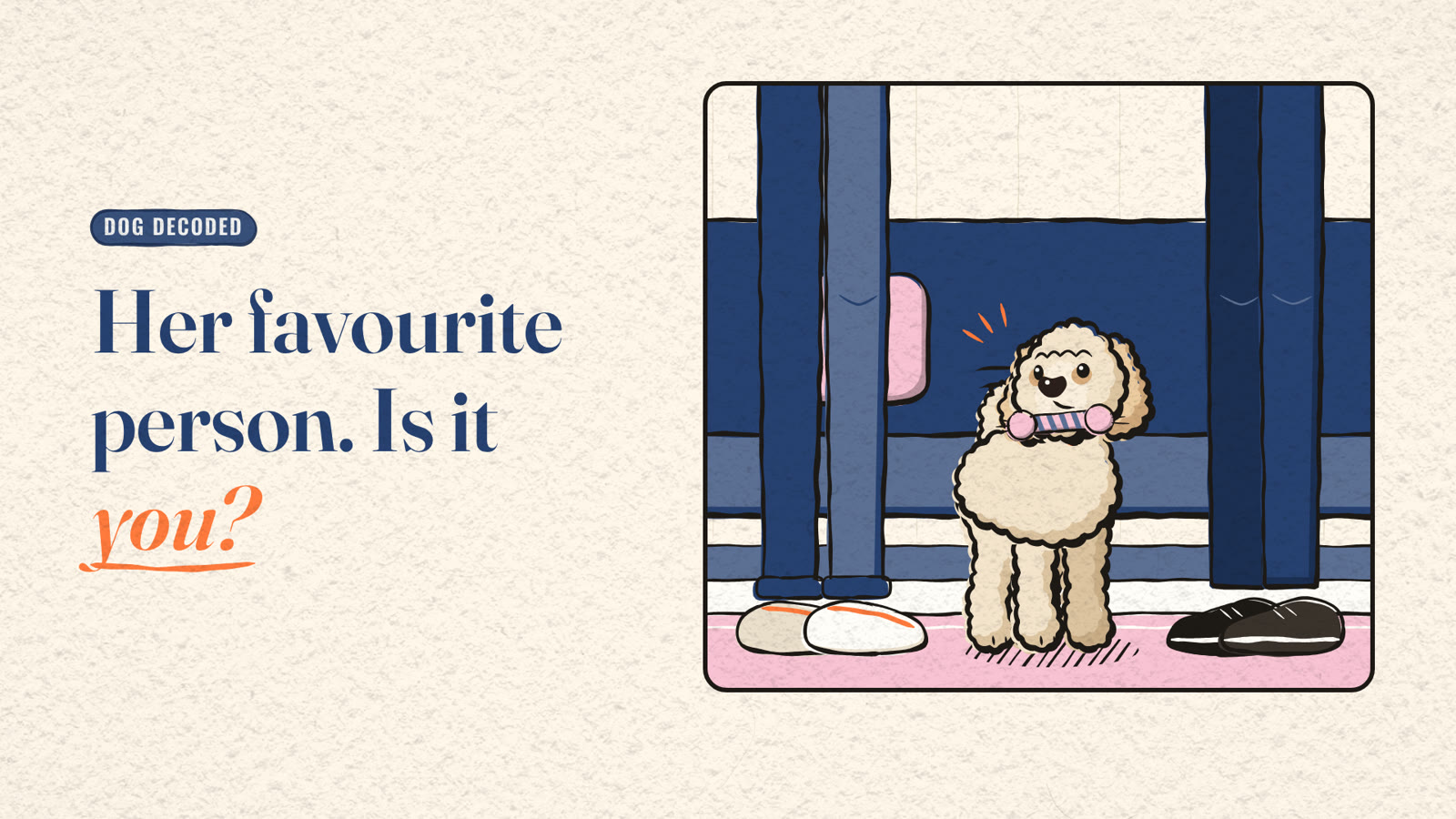
In our short film, Miya stands on the rug between two pairs of feet with her rope toy, and runs the four-sign favourite test until she makes her choice.
What are the four signs you are her favourite?
The four signs in the film are popular behaviour lore, not a scored test. Each one can mean a strong bond, and a dog can love several people at once.
- She greets you first, and for longest. The wiggle that starts at her nose and ends at her tail. Bassett lists extra excitement at greetings as a sign. A caveat from the AKC: the person who is away more often may get the biggest welcome, especially if greetings are rewarded with treats or play. A bigger hello can mean "you were gone longer", not "I like you more".
- She checks in with you somewhere new. At a new park or a busy hawker centre walkway, she trots ahead, sniffs, then looks back to find you. That fits what researchers call a "secure base" (more on that below).
- She brings you her things. A toy at your feet is usually an invitation to play and a sign she enjoys your company. Our post on the ways your dog says "I love you" covers toy gifts and leaning in more detail.
- She leans on you, or falls asleep touching you. The big one. Resting her full weight on you, or dozing with her chin on your slipper, means she feels safe enough to switch off. Bassett describes sleeping near you and showing her belly as trust.
Following you from room to room can be a fifth sign. If that is your dog, see why your dog follows you to the bathroom.
What does the research actually say?
There is good evidence that dogs form real attachments to their people, and some evidence that attention and touch matter to them as much as food. But the studies are small, and none measured "favourite person" in a two-adult home.
- You can be her safe place. In a 2013 study in PLoS ONE, Horn, Huber and Range gave dogs a food puzzle. Dogs worked at it for longer when their owner was in the room, whatever the owner did, and a stranger standing in did not have the same effect. The authors called this an owner-specific "secure base effect", similar to what is seen in young children. The samples were small: 20 dogs in the first experiment and 26 in the second.
- Praise can rival food. In a 2016 brain-scanning study by Cook, Berns and colleagues, 13 of 15 awake dogs showed equal or greater reward-area activity when expecting their owner's praise compared with expecting food. In a maze choice test, each dog's brain response predicted whether it tended to go to its owner or to a food bowl. Fifteen dogs is a very small sample, and the authors note that the praise was brief while the food was a tasty hot dog.
- Touch beats talk. A 2015 study by Feuerbacher and Wynne found dogs stayed closer to a person who petted them than to one who only praised them, even when the praise came from their owner. Vocal praise on its own was hardly more appealing than no interaction at all.
Put together: a calm, kind person who plays, touches gently and rewards often is doing exactly what dogs appear to value. That supports what the film says, but treat "dogs pick whoever does the fun stuff" as a sensible reading of the evidence, not a proven law.
How can you become her favourite?
Spend about five minutes a day doing the fun stuff with her, one to one: play, let her sniff, and teach her one small thing. Five minutes is our practical suggestion, not a research figure. The AKC's tips are the same in spirit: create positive experiences together, offer play, treats and one-on-one time, and be consistently kind.
| Builds the bond | Wears it down | |
|---|---|---|
| Play | A short game of tug or fetch she chooses to join | Teasing, or play that ends in a telling-off |
| Sniffing | Letting her explore at her own pace | Hurrying her past every smell |
| Training | One easy cue, tiny reward, lots of success | Long drills, harsh corrections |
| Touch | Gentle petting where she leans in for more | Grabbing or hugging when she pulls away |
| Mood | Calm, predictable, kind | Shouting, sudden changes, tension at home |
A five-minute plan:
- Two minutes of play. Tug with a rope toy, then let her win sometimes. In an HDB flat, the corridor between rooms is plenty of space.
- One minute of sniffing. Scatter a few treat crumbs on a towel and let her hunt. For outdoor ideas, try a slow sniff walk, early or late in the day when Singapore is cooler.
- Two minutes of training. Teach one small thing, such as sit, touch or a hand target. Stop while she is still keen.
For the training part, tiny, high-value rewards help. Pick something she loves and break it into pieces about the size of a pea, so five minutes of practice does not become a big snack.
Turkey Freeze-Dried Pet Treats (SGD $13.90): Pure turkey. Nothing else. Lean white meat that's gentle on the stomach and great for training.
Our turkey treats are 100% turkey and crumble into tiny pieces, so one cube covers a short session. You can see the rest of the range in our freeze-dried treats. If you live with a partner, take turns: dogs can have more than one favourite, and the "losing" person often gains the most from a daily game.
Is a strong favourite normal, or worth a vet check?
A dog who clearly prefers one person but is relaxed with everyone is normal. A sudden change is the thing to watch: if she suddenly will not leave anyone's side, or starts hiding from her favourite, she may be stressed or in pain, so talk to your vet.
The AKC's guide to signs of pain notes that many dogs are "experts at hiding" pain, and that some become "withdrawn or unusually clingy" when uncomfortable. It lists seeking more attention than usual, and avoiding touch, among possible signs, and warns that slow changes are easy to mistake for ageing or a personality shift. Hiding, a new reluctance to be touched, or growling when handled are all worth a call to the clinic. Short videos of the behaviour help your vet.
There is a second kind of "too much". Bassett separates a dog who is simply very attached from one who is in real distress when apart: nonstop barking or howling, destruction and escape attempts. That can point to separation anxiety, which needs patient training and sometimes professional help. Our guide to helping a dog with separation anxiety explains how to check.
Possessiveness is the third flag. A dog who growls when others come near her favourite person needs gentle management, not a joke about loyalty. Ask your vet or a qualified behaviourist.
Bottom line
Dogs often pick a favourite person, and it is usually whoever makes life fun, safe and predictable, not simply who feeds them. Greetings, check-ins, toy gifts and sleepy leaning are lovely signs, but they are lore, and the research behind them is small. Want more of that wiggle? Five minutes a day: play, let her sniff, teach one small thing. If her clinginess or hiding is sudden, see your vet.
For training rewards, try our Turkey freeze-dried treats. They ship within Singapore, within 24 hours. First order? Use code TRY25NOW for 25% off orders of $25 or more (up to $10 off).
So, be honest: who is your dog's favourite?
Frequently asked questions
Do dogs really have a favourite person?
Many do. Most dogs bond with everyone at home, but often show a clear preference for one person in greetings, check-ins and where they choose to rest. Experts link it to positive experiences and temperament fit. There is little direct research on favourites, so treat the signs as clues rather than proof.
Is my dog's favourite person the one who feeds her?
Not necessarily. The AKC says a dog's strongest attachment often has little to do with who provides the most care. Feeding helps build a bond, but play, training, gentle touch and a calm, kind manner seem to count for more. Many dogs adore the partner who never fills the bowl.
Can my dog change her favourite person?
Yes. Trainers say dogs are not locked into one person for life. A new job, a move, a new baby or simply someone spending more fun time with her can shift the bond. If you want to be closer, a few minutes of daily play, sniffing and training is a good start.
How can I get my dog to like me more?
Do the fun stuff, one to one, for about five minutes a day: a short game of tug, a sniffing game, and one easy cue with tiny rewards. Be calm and predictable, pet her where she leans in for more, and avoid harsh corrections. Consistency over weeks matters more than one big day out.
Should I worry if my dog suddenly becomes clingy?
A sudden change is worth a vet check. Dogs often hide pain, and some become unusually clingy or start hiding when unwell or stressed. If the change is new, especially with appetite, sleep or mobility changes, book a visit. Panic when left alone can point to separation anxiety, which also needs help.
Sources
- AKC: Why does my dog prefer my partner over me?
- Adopt a Pet (formerly Kinship): 7 signs you are your dog's favourite person (with trainer Alexandra Bassett)
- AKC: Signs your dog is in pain
- Horn, Huber and Range (2013), The importance of the secure base effect for domestic dogs, PLoS ONE
- Cook, Prichard, Spivak and Berns (2016), Awake canine fMRI predicts dogs' preference for praise vs food, Social Cognitive and Affective Neuroscience
- AVSAB research review: Dogs prefer petting to vocal praise (Feuerbacher and Wynne, 2015)
This article is general information, not veterinary advice. If your pet has ongoing symptoms, see your vet.