How to Switch Dog Food: The 7 to 10 Day Slow Switch
By BEANS Team · Published
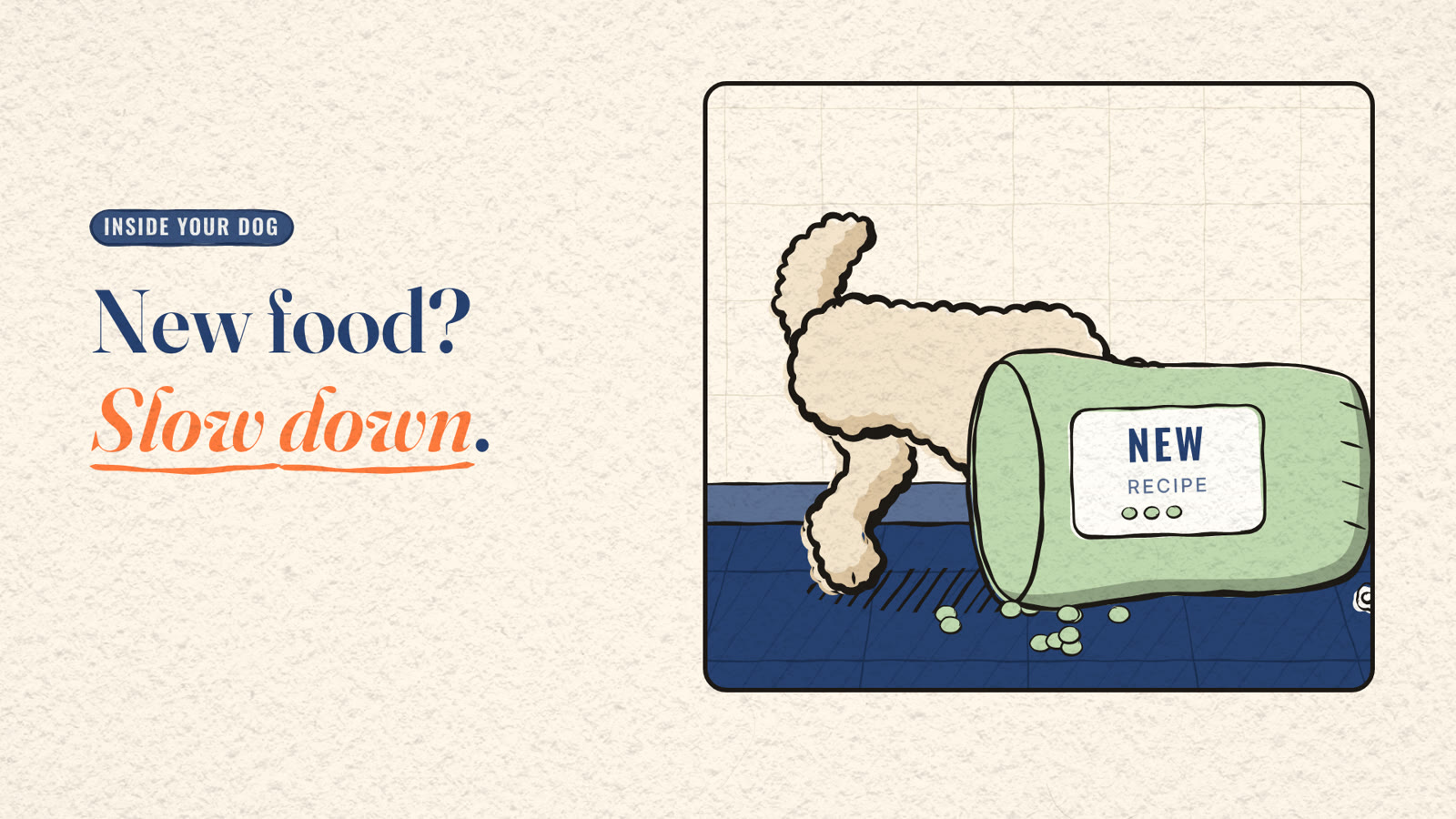
TL;DR
Switch your dog's food over 7 to 10 days, not overnight: a quarter new food, then half, then three quarters, then all new. Her gut microbes need time to adjust. If poop goes soft, go back a step for a day or two. Puppies and sensitive tummies need longer. Call your vet for watery or bloody poop or vomiting.
- A sudden food change can cause wind, soft poop and vomiting because the gut and its microbes are tuned to the old food
- Mix in the new food over 7 to 10 days: a quarter, half, three quarters, then all new, about two days per step
- Soft poop mid-switch? Go back to the last ratio that suited her for a day or two, then carry on more slowly
- Puppies and sensitive tummies need two weeks or more; Tufts says some pets need 4 to 6 weeks
- Call your vet for watery or bloody poop, vomiting, lethargy, a dog off her food, or signs lasting more than a day or two
The new bag is open, it smells amazing, and your dog is already nose-deep in it. The easy thing is to tip it straight into her bowl tonight. Most of us have done exactly that, often because a different food was on offer. For plenty of dogs it ends with wind, soft poop or a sick-up a day later. The fix is simple: switch slowly, over about a week, and know what to do when things wobble halfway. Here is the plan, why it works, and the careful caveats.
Why does switching dog food upset her tummy?
Because her gut, and the microbes living in it, are tuned to the food she eats now. Change everything overnight and they have to adjust all at once.
FirstVet, a vet-written service, explains that a dog's "digestive enzymes and microbiome have adapted to the diet they're used to eating", and that a sudden change of brand or protein can inflame the gut lining and bring on vomiting and diarrhoea. The American Kennel Club (AKC) lists vomiting, diarrhoea and a decreased appetite as signs of an abrupt switch, and Chewy's vet-written guide says sudden food changes can cause vomiting, diarrhoea and gas.
There is lab evidence for the microbe part. In a 2025 study in Frontiers in Veterinary Science, researchers switched 12 healthy adult beagles abruptly from a dry kibble to a canned food. The switch lowered the variety of gut bacteria, reduced groups that make short-chain fatty acids (useful fuel for the gut lining), increased some potentially harmful groups, and raised a "dysbiosis index", a score for an unbalanced gut. Two honest footnotes the film left out: it was only 12 dogs of one breed, all female, and their poop scores did not actually change, although the poop did get wetter. So the microbes clearly shift. How much that matters for any one dog varies.
Want to watch the slow switch in 82 seconds?
In our short film, Miya dives into a NEW RECIPE bag, shows you the gut bugs meeting a whole new menu, then walks through the switch day by day, including the step most people skip.
How do you switch dog food gradually?
Mix a growing share of the new food into the old over 7 to 10 days. Each step lasts about two days.
Save this:
- Days 1 and 2: a quarter new food, three quarters old.
- Days 3 and 4: half and half.
- Days 5 and 6: three quarters new, a quarter old.
- Day 7: all new.
That is the same 25, 50, 75 and 100 per cent pattern the AKC, Chewy and FirstVet use. The sources differ a little on timing. The AKC says 5 to 7 days, Chewy suggests two to three days per step, which works out at about 7 to 10 days, and Tufts University's Petfoodology blog, written by a board-certified veterinary nutritionist, recommends mixing in the new food "over the course of at least one week". Tufts starts even gentler, at 10 per cent new on day one, and so does PetMD. If your dog has a history of tummy trouble, starting at 10 per cent is a sensible tweak.
Two practical points the film didn't have time for:
- Match calories, not cups. Tufts points out that foods vary in calories, so one cup of the old food may be "much more or less" than one cup of the new. Check the feeding guide on the new bag and estimate. For a few days, a gradual switch matters more than exact numbers.
- Keep everything else steady. A new food plus new treats, chews and table scraps in the same week makes it hard to tell what caused a soft poop. Our guide to how many treats a dog should have helps you keep extras small.
What should you do about soft poop during the switch?
Don't give up and don't push on. Go back a step for a day or two, then carry on more slowly.
Tufts is reassuring here: "some soft stool can occur during a diet change." If your dog has minor signs, such as loose stool or a little tummy gurgling, but is otherwise acting fine, Tufts says you can continue, just stretch the plan out. Their example matches the film: loose stool on day 3 at half and half? Stay at the most recent ratio that did not cause issues "for another day or two until symptoms pass, then continue with the transition."
Other vets are more cautious. Chewy's guide says that if your pet has a negative reaction, go back to the old diet for a week, then try again starting with a smaller amount of new food, such as 10 or 15 per cent. PetMD suggests going back to the old food for a few days until the poop is normal. So "back a step" is the gentle option for mild softness; a full reset to the old food is reasonable if it's more than mild.
Not sure what counts as soft? "Loose" means different things to different people, and Tufts suggests describing it with a poop chart. Our dog poop chart shows what firm, soft and watery look like.
How long should a switch take for puppies and sensitive tummies?
Longer than a week. We suggest two weeks or more, and some dogs need a month or longer.
Tufts says some pets can switch "from one food at breakfast to another at dinner with no problems, while other pets require 4-6 week transitions to avoid stomach upset." The AKC says dogs with sensitive stomachs, food allergies or other gut conditions "may need a longer transition period", and Chewy agrees. None of the sources we read gives a puppy-specific timetable, so our two-week figure is a cautious floor, not a rule. PetMD does warn that the "quick switch" method, where a dog skips a meal before starting the new food, should not be used for puppies or dogs with health problems.
| Standard switch | Slow switch | |
|---|---|---|
| Who it suits | Healthy adult dogs | Puppies, sensitive tummies, past food reactions |
| Total time | 7 to 10 days | 2 weeks or more; some need 4 to 6 weeks |
| First step | 25% new | 10% new |
| Each step lasts | About 2 days | 3 to 4 days or longer |
| If poop goes soft | Back a step for a day or two | Back a step, or back to the old food, then go slower |
If you are changing food because you suspect an allergy, that is a different job: a vet-led elimination diet. See our posts on food allergy in dogs and the elimination diet, week by week.
When should you call the vet?
When it's more than a bit of soft poop. Call your vet if you see:
- watery or bloody poop
- vomiting, especially more than once
- she's off her food, lethargic or seems in pain
- signs that last more than a day or two
Tufts lists continued vomiting, liquid diarrhoea, pain or lethargy as reasons to call, because "there may be something else going on", your dog may not tolerate something in the food (such as fat or fibre), or she may need supportive care. PetMD says to talk to your vet about severe diarrhoea or vomiting, or milder signs that don't clear up in a couple of days. Chewy adds a useful rule: if your dog reacts badly no matter how slowly you switch, call your vet, because the new food may simply not suit her.
Sometimes there is no time for a slow switch, for example when a food is recalled, discontinued or your vet wants an immediate change. PetMD describes a quicker method for those cases, not suitable for puppies or dogs with health problems, so ask your vet how to handle it.
Can probiotics help during a food switch?
Possibly, as support, but the evidence is mixed and they are no substitute for going slowly.
PetMD says a probiotic "can also help" a dog with mild diarrhoea during a switch. The 2025 beagle study, though, is a useful reality check: it tested a probiotic (a Bacillus subtilis strain) and found it "did not attenuate the microbial shifts caused by the diet transition". That was one strain, at two doses, in 12 dogs, and the study was funded by the probiotic's maker, so it doesn't settle the question either way. Different strains may behave differently. The honest summary: a gradual switch does the heavy lifting; a probiotic may help support a happy gut alongside it.
Digestive Probiotics (SGD $34.80): Firmer poops, happier walks. Prebiotics, probiotics and pumpkin in a soft chew your dog thinks is a treat.
Our Digestive Probiotics are soft chews with three probiotic strains, prebiotic fibre and pumpkin, made to help support firmer poops. They are for dogs only, and we ship within Singapore only. If you start them, ideally do it before or alongside the slow switch, not as a fix for a rushed one, and check with your vet first if your dog is on medication or has a health condition.
Bottom line
Switching dog food in one go is a fast track to an upset tummy. Go slow instead: a quarter, half, three quarters, then all new over 7 to 10 days. Soft poop on the way? Go back a step for a day or two, then carry on slower. Puppies and sensitive tummies need two weeks or more. Watery or bloody poop, vomiting, or a dog off her food means a call to your vet.
For gut support while she learns the new menu, take a look at our Digestive Probiotics. How did your dog take her last food switch?
Frequently asked questions
How long does it take to switch dog food?
Most healthy adult dogs do well with 7 to 10 days. Mix a quarter new food for two days, then half and half, then three quarters, then all new. Tufts recommends at least a week. Puppies and dogs with sensitive tummies may need two weeks or more, and some need 4 to 6 weeks.
Is it OK to switch dog food without mixing?
Some dogs cope, but many get wind, soft poop or vomiting, so a gradual switch is safer. The exceptions are a recalled or discontinued food, or a vet asking for an immediate change. In those cases ask your vet how to do it, and don't use a skipped-meal method for puppies.
What should I do if my dog gets diarrhoea when switching food?
For mild soft poop in a dog acting normally, go back to the last ratio that suited her for a day or two, then continue more slowly. If it's more than mild, return to the old food until her poop is normal. Watery or bloody poop, or vomiting, means calling your vet.
Is soft poop normal when changing dog food?
A little soft stool can happen during a diet change, according to Tufts University's Petfoodology blog. It usually settles if you slow the switch down. It isn't normal if the poop is watery or bloody, if she is vomiting or off her food, or if it lasts more than a day or two.
Do probiotics help when switching dog food?
They may help support gut health, and PetMD says a probiotic can help mild diarrhoea during a switch. Evidence is mixed: a small 2025 study found one probiotic strain did not prevent the gut microbe shifts of an abrupt switch. Treat probiotics as support alongside a slow switch, not a replacement for one.
Sources
- AKC: How to switch and transition dog foods
- Chewy (Sarah Wooten, DVM): How to switch your pet's food
- Tufts Cummings School Petfoodology: How do I switch my pet's food?
- Frontiers in Veterinary Science (Oba et al., 2025): Bacillus subtilis and the faecal microbiota of dogs after an abrupt diet change
- FirstVet: Why does my dog get diarrhoea after changing his diet?
- PetMD (Jennifer Coates, DVM): How to switch your dog's food
This article is general information, not veterinary advice. If your pet has ongoing symptoms, see your vet.