Why Does My Dog Stare at Nothing? (No, It's Not a Ghost)
By BEANS Team · Published
TL;DR
There is no evidence dogs see ghosts. A dog staring at a wall or corner is usually tracking a sound, scent or small movement you can't detect. Staring now and then is normal. Long spells, getting stuck in corners or snapping at the air, especially in an older dog, are worth filming and showing your vet.
- Dogs hear sounds up to about 47,000 to 65,000 Hz, against about 20,000 Hz for adult humans
- More rods and a reflective tapetum lucidum help dogs see better in dim light, and spot slighter movements
- In Singapore homes, the culprit in the corner is often a cicak, a moth or a noise in the wall
- Regular long stares, getting stuck in corners or air snapping can point to cognitive dysfunction or focal seizures
- Film the episodes, note the date, time and length, and show your vet
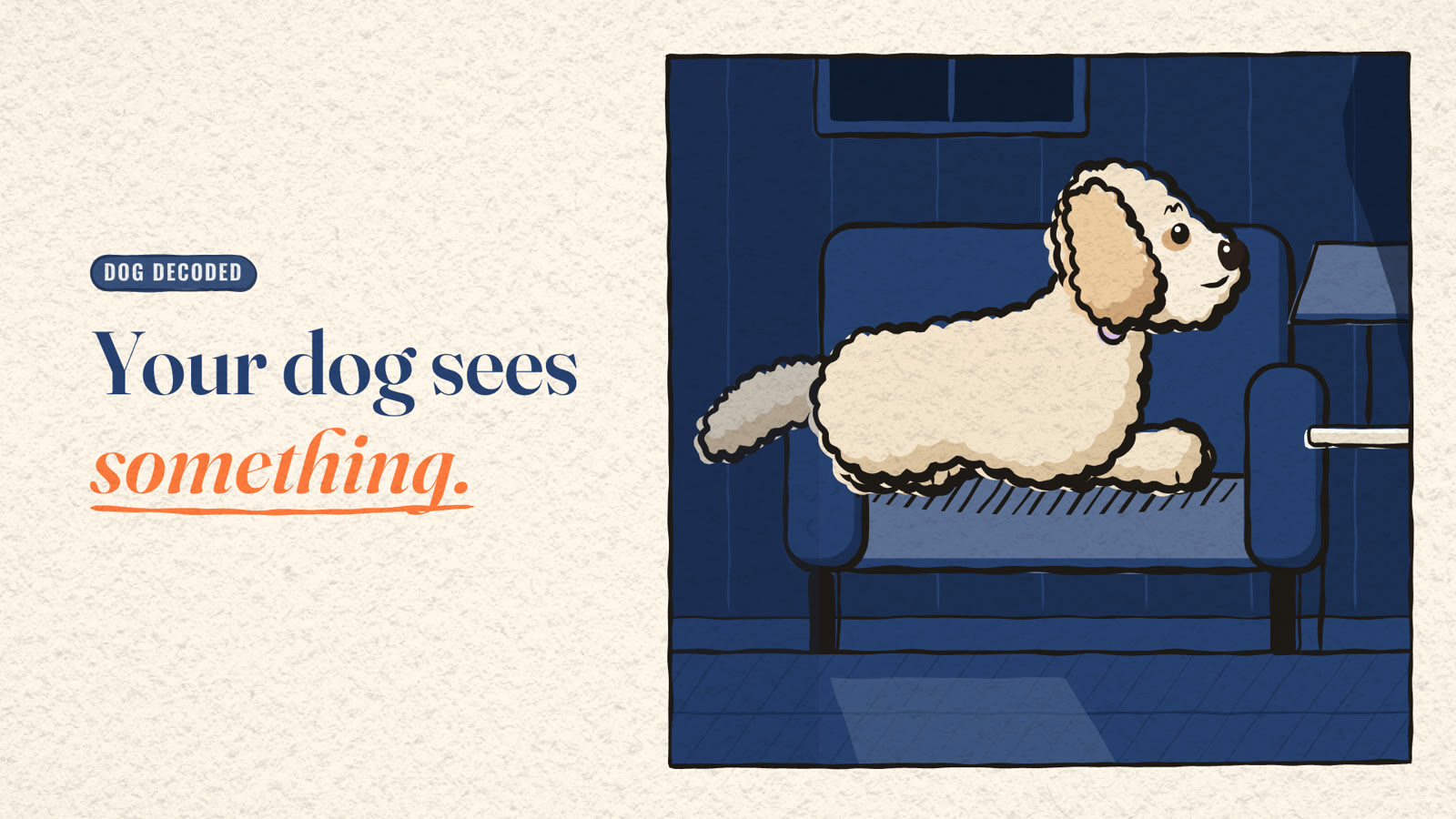
It is late, the flat is quiet, and your dog is staring at a blank corner. Ears up. Very still. It is Halloween, so the ghost theory is tempting. The honest answer is that there is no evidence dogs see ghosts. But your dog really can hear, smell and see things you can't, and that usually explains the stare. Once in a while, though, staring is a health clue worth showing your vet.
Why does my dog stare at nothing?
Usually because it isn't nothing to her. Dogs hear higher and quieter sounds than we do, pick up scents we can't, and spot small movements in dim light. A stare at a wall or corner is most often her tracking something real that you simply can't detect.
The American Kennel Club (AKC) asks the ghost question directly. Its answer: "Scientifically speaking, however, the answer is 'no.'"
The film is the friendly version. This post is the careful version, with the numbers, the caveats the film left out, and every source at the end. None of it replaces your own vet.
Want to watch the three clues in 71 seconds?
We turned the three a.m. stare into a short film with Miya, our Goldendoodle, following her ears, nose and eyes towards a dark corner until the lamp clicks on.
Can my dog hear something in the wall?
Quite possibly. Dogs hear sounds far higher and quieter than people can, so a scratch, a buzz or a distant hum that is silent to you can be loud enough to hold her attention.
According to the AKC, the average adult human can't hear sounds above about 20,000 Hz, while dogs can hear sounds as high as 47,000 to 65,000 Hz. The AKC also cites psychologist Stanley Coren's work showing that, across part of the range, dogs can detect sounds at around -5 to -15 dB, quieter than the faintest sound a young person can typically hear.
One area where we win: the AKC says people can locate sounds about one degree apart, while dogs generally need around eight. So she may hear a sound clearly but need to stare and tilt her head to pin down where it is.
The AKC suggests sitting next to her, listening quietly and pressing your ear to the wall. Pests can live in walls unnoticed. In a Singapore flat, the lift, a neighbour's pipes or an air-con unit can also hum at the edge of our hearing.
Can my dog smell someone who has already gone?
Her nose is far better than yours, so a scent that is nothing to you can be very interesting to her. The AKC says people have around 5 to 6 million scent receptors, while dogs have up to 100 million or more depending on breed.
The AKC adds that the smelling part of a dog's brain is about 40 times larger than ours. So a visitor, a delivery in the corridor or a neighbour's dog walking past can leave a trail she wants to study.
The careful part: in the film we say someone walked past "an hour ago". That is an example, not a measured number. We could not find a reliable figure for how long a scent lasts in a home, and it will depend on the air, the surface and the dog. On a humid night with the windows open, smells also drift in from outside, so a nose pressed to the gap under the door is very normal.
Can dogs see in the dark?
Better than you can, yes, though not in total darkness. Dogs have more light-gathering rods in the retina than we do, plus a reflective layer behind it called the tapetum lucidum, which gives dim light a second pass.
The AKC explains that rods gather dim light, which "enables better night vision", while the human retina is dominated by cones, which handle colour and daylight. The tapetum lucidum is a layer of reflective cells behind the retina. It is the reason for that eerie glow in flash photos and headlights. The AKC describes it as greenish-yellow, though it can be green, blue, orange or yellow, and some dogs, most often those with blue eyes, have no tapetum and show red eyes in photos instead.
Dogs are also tuned for movement. AKC Chief Veterinary Officer Dr Jerry Klein says dogs have a higher flicker fusion threshold than humans, which "allows the dog to detect slighter movements in the dark." A moth crossing the ceiling, a car's headlights sweeping across the wall or a shadow from the corridor light can catch her eye long before it catches yours.
So what was in our corner?
In our film, a cicak. The common house gecko is one of the most familiar animals on Singapore walls, and anyone who grew up in an HDB flat knows its "chik-chak" call. It moves in short bursts near the lights where insects gather.
That is a perfect target for a dog's ears and eyes: a quiet click, a tiny dart, then stillness. If your dog stares at the same high corner most evenings, look up before you worry. Moths and beetles drifting in on humid nights count too.
When is staring worth a vet check?
Staring now and then is normal. Long spells at a wall, getting stuck in corners, snapping at flies that aren't there, or staring along with other new changes, especially in an older dog, are worth a vet check. Film it so your vet can see.
The AKC is clear that catching your dog staring at a wall once does not mean something is wrong. But it names two medical causes that are more likely than infestations or ghosts.
Canine cognitive dysfunction (CCD). This is an age-related decline in thinking and memory, often compared with Alzheimer's disease in people. The AKC says the most common forms of disorientation in CCD include walking aimlessly, getting stuck in corners and staring at walls. The Merck Veterinary Manual lists signs under the acronym DISHAA: disorientation, changes in social interactions, sleep-wake cycles, house soiling, anxiety and activity. Merck cites one study in which 28% of dogs aged 11 to 12 and 68% of dogs aged 15 to 16 showed signs consistent with it. It also cites an internet survey that found more than 85% of likely cases had not been diagnosed. Those are single studies, not a rule for your dog.
Focal seizures. Not every seizure is dramatic. The AKC says staring at a wall or into space can be a sign of a partial or focal seizure, which affects only part of the brain. VCA Animal Hospitals describes fly-biting, where a dog snaps at the air as if at invisible flies, as one type of focal seizure, often starting while the dog is resting.
The careful part: fly-biting is not always a seizure. Merck lists jaw snapping, sometimes called fly biting, among behaviours where vets should also consider gut and metabolic problems, and the AKC lists it among possible compulsive behaviours. VCA says the only way to confirm a focal seizure is an EEG during an episode, which is rarely practical, so vets usually rule other causes out first. That is exactly why your video matters.
| What you see | Most likely normal | Worth a vet check |
|---|---|---|
| How often | Now and then, at a sound or movement | Regularly, or more and more often |
| How long | A few seconds, then she moves on | Long spells, hard to break |
| What she does | Head tilt, ears up, sniffing, then relaxes | Stuck in a corner, walking aimlessly |
| Snapping | Snaps at a real fly or moth | Snaps at the air, often while resting |
| Age and other changes | Any age, otherwise her usual self | An older dog with new night waking, toilet accidents or less interest in you |
What should I do if my dog keeps staring at the wall?
Stay calm, check for a real cause, and if it keeps happening, film it and book a vet visit.
- Look and listen first. Sit beside her. Check the corner, the ceiling and the wall for a cicak, insects or a noise.
- Try a gentle call. Say her name or offer a treat. A dog who snaps out of it and trots over is usually fine.
- Film it. A short video on your phone shows your vet what a description can't. Write down the date, time and length.
- Note anything else new. Changes in sleep, toilet habits, appetite or how she greets you all help your vet.
- Don't reward the stare by accident. The AKC notes some dogs learn that staring gets attention. Reward her for settling instead.
If you have a senior dog, our guide to where your dog sleeps and what it means covers when sleep changes are worth a vet visit too.
Can I help a restless dog settle at night?
A calm routine helps most dogs: a last toilet trip, a quiet hour and the same bed spot, plus enough to do during the day. Our 5 games to tire out your dog indoors are an easy start. If she startles at evening noises, reward calm rather than telling her off, as we explain in why dogs look guilty.
Calming (SGD $34.80): Less drama at the door. L-theanine, chamomile and valerian root to help anxious pups find their chill.
Our Calming chews are made with L-theanine, chamomile and valerian root to support dogs who find it hard to wind down. They are for dogs only, not cats, and they are currently on pre-order with restock expected on 1 November 2026. They are not a treatment for cognitive decline or seizures, so see your vet first if you have any of those worries or if your dog takes medication.
Bottom line
There is no evidence your dog sees ghosts. She hears higher and quieter sounds, smells far more, and spots small movements in the dark, so the corner is usually hiding a sound, a scent or a cicak. Staring now and then is normal. Long spells, getting stuck in corners or snapping at nothing, especially in an older dog, are worth filming and showing your vet.
Want more of your dog, decoded? Read 5 ways your dog says "I love you" next, and tell us on our socials what your dog stares at.
Frequently asked questions
Can dogs see ghosts?
There is no scientific evidence that they can. The AKC answers the question with a plain no. What dogs do have is sharper hearing, a far stronger sense of smell and better vision in dim light, so they notice sounds, scents and movements we miss. That is the most likely reason for the stare.
Why does my dog stare at the corner at night?
Most often she is tracking something real: a cicak or moth near the ceiling, a sound in the wall, or headlights sweeping across the room. Dogs see better than us in dim light and detect slighter movements. If she stares often, for long spells, or gets stuck there, film it and show your vet.
Is my senior dog staring at the wall a sign of dementia?
It can be. Canine cognitive dysfunction, often compared with Alzheimer's disease, can cause staring at walls, getting stuck in corners and walking aimlessly. Other signs include changes in sleep, toilet habits and how your dog interacts with you. Only a vet can diagnose it, after ruling out other causes, so book a check.
What is fly-biting in dogs?
Fly-biting is when a dog snaps at the air as if catching invisible flies, often while resting. VCA describes it as a type of focal seizure, but vets also consider gut problems and compulsive behaviour. Diagnosis usually means ruling other causes out, so a video of the episode is very helpful to your vet.
Why do my dog's eyes glow in photos?
That glow comes from the tapetum lucidum, a reflective layer of cells behind the retina that gives dim light a second pass. It helps dogs see better at night. The colour can be green, blue, orange or yellow. Some dogs, often blue-eyed ones, have no tapetum and show red eyes instead.
Sources
- AKC: Why is my dog staring at the wall?
- AKC: Sounds only dogs can hear
- AKC: Can dogs see in the dark?
- AKC: Why does my dog sniff everything?
- Merck Veterinary Manual: Behavioral problems of dogs (cognitive dysfunction syndrome)
- VCA Animal Hospitals: Focal seizures and fly-biting in dogs
- NParks Flora and Fauna Web: Hemidactylus frenatus (common house gecko)
This article is general information, not veterinary advice. If your pet has ongoing symptoms, see your vet.