Why Do Dogs Look Guilty? That Face Isn't Guilt (and What to Do Instead)
By BEANS Team · Published
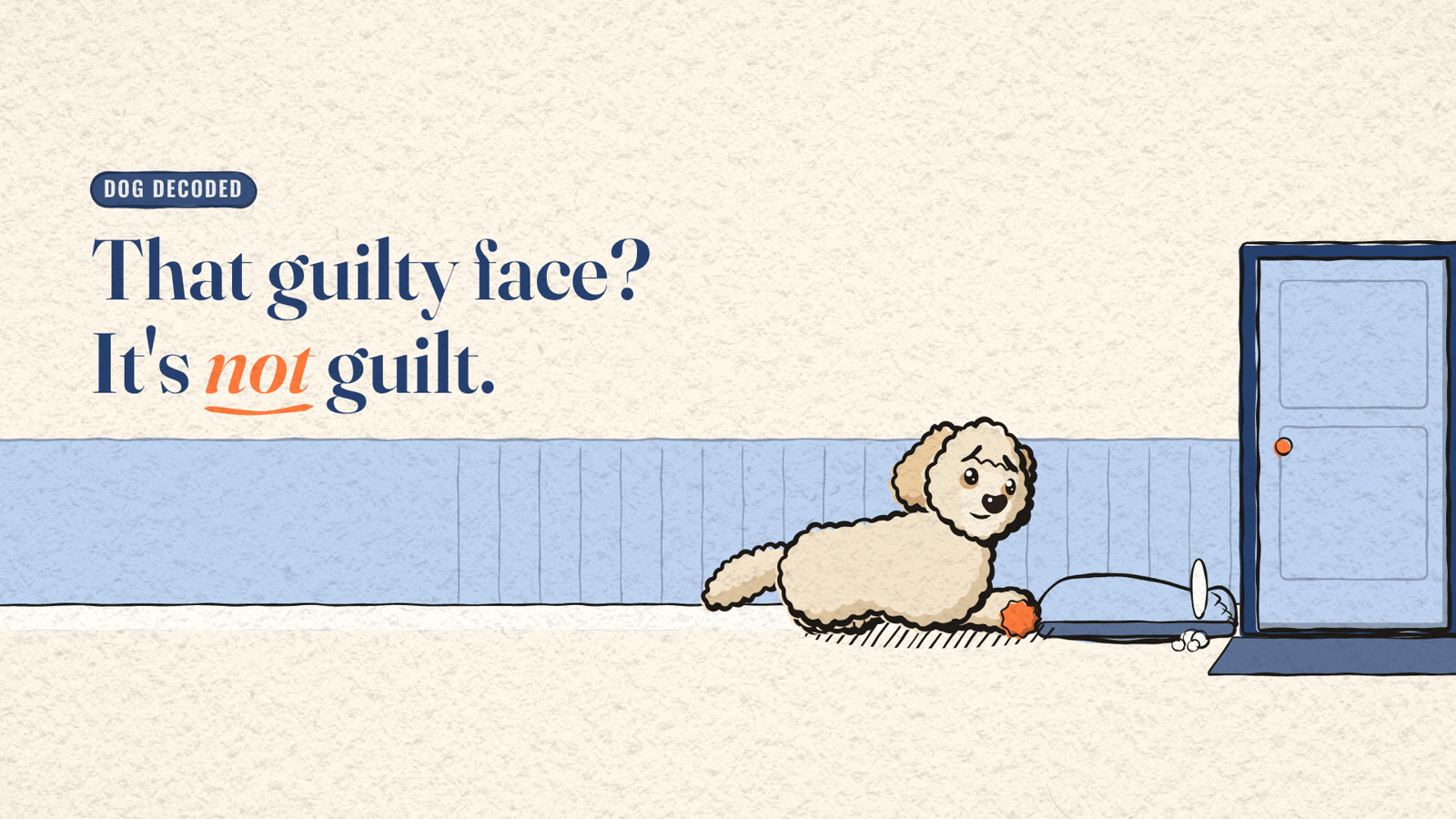
TL;DR
The guilty look (ears back, eyes away, tail low) is most likely a response to your face and voice, not a confession. In small studies dogs looked just as guilty whether or not they had misbehaved, and most when scolded. Skip the telling-off: greet calmly, swap and praise in the act, and put shoes away.
- In Horowitz 2009 (14 dogs) the guilty look didn't depend on whether the dog had eaten the forbidden treat
- Scolded dogs showed about four times as many guilty-look behaviours as dogs greeted kindly
- Dogs can't link a telling-off to chewing done hours or even minutes earlier
- Instead: a calm hello, a swap and praise when you catch her in the act, and shoes put away
- Chewing only when alone, with howling or scratching at the door, is worth a vet or behaviourist visit
You walk in, there's a chewed slipper in the hallway, and your dog greets you with ears back, eyes sliding away and a quick lip lick. It looks exactly like guilt. The research says it probably isn't, and what most of us do next (the telling-off) is the part that backfires. Here is what the studies found, where they fall short, and three things to do instead.
Is that guilty look really guilt?
Probably not. In the best-known study, dogs showed the "guilty look" just as much whether or not they had broken the rule, and showed it most when their owner scolded them. It looks more like a response to you than an apology.
That doesn't prove dogs never feel anything like guilt. The researcher, Alexandra Horowitz, says her results "do not indicate that domestic dogs do not experience guilt." They show that the face we read as guilt tracks the owner's behaviour, not the dog's misdeed. So the kinder reading is not "I'm sorry" but "please don't be cross."
Want to watch why that guilty face isn't guilt in 87 seconds?
Our Dog Decoded film follows Miya and a chewed slipper, shows what the guilty face really means, and ends with the three swaps that work better than a telling-off.
What does the guilty look actually look like?
It is a bundle of small signals: eyes turned away, head and ears down, tail low, a quick low wag, a lip lick, or rolling onto the back. Most dogs show a few, not all.
Horowitz built her list from what owners described. The nine behaviours: avoiding eye contact, lying down and rolling to the side or onto the back, dropping the tail, wagging low and quickly, holding the ears or head down, moving away from the owner, raising a paw, and licking. No dog showed more than five in one trial.
The ASPCA lists the same signals as submissive postures in dogs being reprimanded: "holding the tail low, flattening the ears back against the head, crouching or rolling over and exposing the belly." Horowitz suggests the guilty look may be "a look of fearful anticipation of punishment by the owner." (Dogs have plenty of happier faces too; see 5 ways your dog says "I love you".)
What did the guilty look study actually find?
Dogs looked just as "guilty" whether they had eaten a forbidden treat or not. What changed the look was the owner: scolded dogs showed about four times as many guilty-look behaviours as dogs greeted kindly.
In the 2009 study in Behavioural Processes, owners told their dog not to eat a treat, then left the room. The researcher then either gave the dog the treat or removed it. On return, owners were told whether the dog had eaten it, but that report was sometimes false on purpose. Owners told "she ate it" scolded; the others gave a friendly greeting. The dog was scored for the first 10 seconds after the owner came back.
- Whether the dog had actually eaten the treat made no significant difference to the guilty look.
- Being scolded did. On average dogs showed 2.4 guilty-look behaviours when scolded and 0.6 when greeted.
- The look was strongest when an innocent dog was scolded.
The caveats. The film is the friendly version, so here is the careful one.
- It was small. Horowitz tested 14 dogs (six male, eight female), all in their owners' apartments, all the only dog at home.
- It was a treat, not a slipper. We are extending a food test to a chewing scene.
- It was a set-up test. A researcher with a camera stayed in the room, and Horowitz scored every video herself, with an independent coder checking a sample.
- Some details are hints, not findings. Dogs who had been to obedience classes showed more guilty behaviours when scolded, and the three dogs whose owners also used physical punishment were among the four with the strongest looks. Horowitz flags that second point as preliminary.
Later work points the same way. In a 2015 study of 96 dogs in Croatia, Ostojić, Tkalčić and Clayton had owners return and act neutrally. Owners could not tell from the greeting whether their dog had eaten the forbidden food any better than chance, and neither the dog's action nor the food left in view changed the greeting as owners saw it. They describe an earlier study (Hecht, Miklósi and Gácsi, 2012) as more mixed: owners guessed better than chance overall, probably from seeing their dog in a baseline trial, but those judging from the greeting alone could not reliably tell. The authors add that an experimenter in the room may have muddled things, so the question is not fully settled.
Why does telling her off after the fact backfire?
Because she can't link your words to the slipper she chewed hours ago. She links them to what is happening now: you walking in. The ASPCA is blunt: "He cannot connect your punishment with some behavior he did hours or even minutes ago."
So what a homecoming telling-off can teach is that your arrival is sometimes scary. The Calgary Humane Society says punishment "does not discourage the behaviour and may cause fear and aggression in your dog." If the chewing is driven by stress about being alone, the ASPCA warns that punishing an anxious dog means "he may become even more upset and the problem could get much worse."
Horowitz also points out how little it takes: "Merely uttering a dog's name with a rising, accusatory tone is often enough to elicit preemptive submissive behaviour." Your tone on the way in can produce the face before you have even seen the slipper.
What should I do instead when I find a chewed slipper?
Three swaps from mainstream vet and shelter advice: a calm hello, a swap and praise when you catch her in the act, and prevention.
1. A calm hello, and clear it up without a fuss. Say hello, wait for her to settle, then quietly put the slipper away. The ASPCA recommends calm comings and goings for anxious dogs: "say hello to your dog and then don't pay any more attention to him until he's calm and relaxed." For what a relaxed welcome looks like, see our welcome home scale.
2. Catch her in the act? Swap it. This is the only moment a response teaches anything. Calgary Humane's advice: "interrupt the behaviour, offer him an acceptable chew toy instead, and praise him lavishly when he takes the toy in his mouth." Cornell vet Brian Collins puts it the same way: "Just take the object away, replace it with a toy, and reward the good behavior." Calgary also suggests teaching a "drop it" cue by practising swaps of the item for a treat or toy.
3. Stop it before it starts. Shoes go in the cupboard, she gets a good walk with time to sniff, and she gets a chew toy as you leave. Calgary says to put away socks and shoes "so your dog is unable to practice the behaviour." The ASPCA suggests exercise before you leave her alone, and a food puzzle toy each time you go. Collins adds one rule: don't hand over old shoes or T-shirts as toys, because "he can't tell the difference."
| What you might do | What she most likely learns | Try this instead |
|---|---|---|
| Show her the slipper and scold | Your arrival can be scary | Calm hello, then tidy it away |
| Shout when you catch her chewing | To be wary of you, not of slippers | Swap for a chew toy, then praise |
| Give her an old shoe to chew | Shoes are toys | Only her own toys, rotated |
| Leave the shoes out and hope | Shoes are always there to chew | Shoes away, sniffy walk, chew toy as you leave |
In an HDB flat the shoe rack by the door is usually ground zero, so a closed cabinet does a lot of the work. In Singapore's heat, an early morning or evening walk is the comfortable time for a long sniff. On wet days, our indoor games guide has nose work that tires her out without going far.
Turkey Freeze-Dried Pet Treats (SGD $13.90): Pure turkey. Nothing else. Lean white meat that's gentle on the stomach and great for training.
For "drop it" practice you want a small reward she will happily trade for. Our Turkey Freeze-Dried Pet Treats are 100 percent turkey and break into small pieces, or crumble a few into a food puzzle toy as you leave. They are a reward, not a chew toy, so keep a proper toy for chewing and count treats as part of her daily food.
Is chewing while I'm out a sign of separation anxiety?
Sometimes. If the chewing only happens when you're out, and comes with howling, scratching at the door or pacing, it can be stress about being alone. That needs a vet or a qualified behaviourist rather than a telling-off.
The ASPCA lists chewing "on objects, door frames or window sills" and digging at doors as possible signs, and notes that if destruction is caused by separation anxiety, it doesn't usually happen while you are there. It suggests seeing your vet first to rule out medical issues and, for moderate or severe cases, a certified applied animal behaviourist or a board-certified veterinary behaviourist.
Plenty of chewing is not anxiety. Calgary Humane lists boredom, few toys or little company, and being under two years old as common reasons, and the ASPCA notes young dogs often chew whether you're home or not. A rough guide:
- Chews whether you are home or not, seems relaxed: likely boredom or age. More exercise, more toys, more swaps.
- Chews only when alone, plus howling, scratching at the door, pacing or toileting indoors: possible separation stress. Book a vet visit.
- Chews door frames or window sills, or hurts her mouth or paws trying to get out: see your vet soon.
Bottom line
That guilty face is most likely a reaction to your face and voice, not a confession. The studies are small but point the same way: scolding makes the look bigger, and a telling-off hours later can't teach her about the slipper. Greet her calmly, swap and praise when you catch her in the act, and put the shoes away. If the chewing only happens when she's alone, talk to your vet.
Stocking up for those "drop it" swaps? Browse our best-selling single-ingredient treats.
Frequently asked questions
Do dogs feel guilty when they do something wrong?
We don't know for sure, but the guilty look isn't good evidence that they do. In Horowitz's 2009 study, dogs looked just as guilty whether or not they had eaten a forbidden treat, and looked most guilty when scolded. The author stresses this doesn't prove dogs never feel guilt.
Why does my dog look guilty before I've even found the mess?
She may be reading you. Horowitz notes that saying a dog's name in a rising, accusatory tone is often enough to trigger the look. A 2015 study found owners couldn't tell from the greeting whether their dog had eaten forbidden food any better than chance, though more research is needed.
Should I show my dog what she chewed and tell her off?
No. The ASPCA says a dog cannot connect punishment with something done hours or even minutes ago, so she is more likely to learn that your homecoming can be scary. Greet her calmly, tidy the item away without fuss, and focus on prevention and swaps you can make in the moment.
What should I do if I catch my dog chewing my shoe?
Interrupt gently, take the shoe, offer one of her own chew toys and praise her warmly when she takes it. That is the advice from Calgary Humane Society and a Cornell vet. Practising a "drop it" swap for a treat or toy at calm times makes the real moment easier.
Is my dog chewing because of separation anxiety?
Possibly, if it only happens when she's alone and comes with howling, scratching at doors, pacing or toileting indoors. The ASPCA says separation-related destruction usually doesn't happen while you're home. See your vet first to rule out medical issues, then a qualified behaviourist if needed. Don't punish it.
Sources
- Horowitz 2009, Disambiguating the "guilty look": salient prompts to a familiar dog behaviour (Behavioural Processes, PubMed)
- Horowitz 2009, full paper (Barnard College PDF)
- Ostojić, Tkalčić and Clayton 2015, Are owners' reports of their dogs' 'guilty look' influenced by the dogs' action and evidence of the misdeed? (Behavioural Processes)
- ASPCA: Destructive chewing
- ASPCA: Separation anxiety
- Cornell University College of Veterinary Medicine: Chew this, not that (Brian Collins via WebMD)
- Calgary Humane Society: Destructive chewing (PDF)
This article is general information, not veterinary advice. If your pet has ongoing symptoms, see your vet.