Why Does My Dog Look Back at Me on Walks? The 3 Check-Ins
By BEANS Team · Published
TL;DR
When your dog looks back on a walk, she is usually checking in: a quick glance to keep track of you, a question at a fork or stranger, or coming all the way back when something is too much. Reward check-ins with a tiny treat. If she suddenly keeps stopping and staring, check the ground, her paws and your vet.
- Looking back on walks is usually a check-in: she is keeping track of you, and trainers treat it as a habit worth building
- There are three common kinds: the quick glance, the question at a fork, smell or stranger, and coming all the way back when something is too much
- Small lab studies suggest most dogs look to their owner when unsure and respond more to the owner's message than a stranger's, but the evidence is limited
- Mark each look with "yes" and a pea-sized treat; the more you reward check-ins, the more she offers them
- A sudden change, such as stopping and staring back, lifting a paw or not wanting to walk, means check the pavement heat, her paws and then your vet
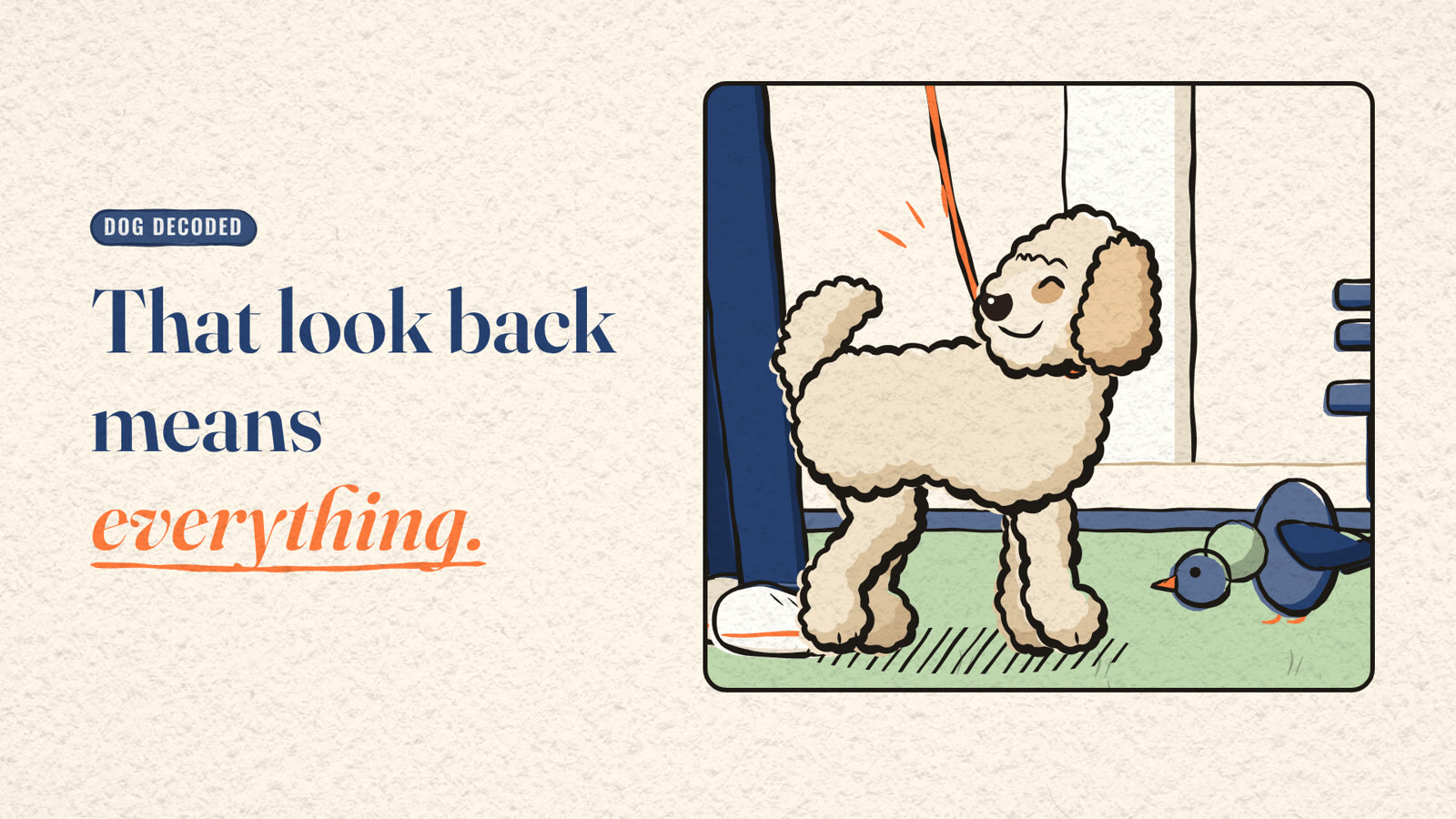
You are halfway along the grass verge by the void deck. She trots ahead on a loose lead, then flicks a look back over her shoulder at you. A few metres later, she does it again. Trainers have a name for those looks: check-ins. Here is what the three kinds of look back usually mean, what the research does and does not show, how to get more of them, and when a look back is worth a closer check.
Why does my dog keep looking back at me on walks?
Usually she is checking in: making sure you are still there, which way you are going, and whether things are fine. Most of the time it is a good sign that she is paying attention to you.
"Checking in" is the standard trainers' term. Writing in Whole Dog Journal, trainer and behaviour consultant Nancy Tucker describes it as a dog looking to her person for direction and affirmation, and treats it as a habit worth building: "When your dog looks to you for direction and affirmation, you both gain freedom."
Trainer Maggie Theisen, writing for Not A Bully Dog Training, lists a few everyday reasons a dog looks back:
- Keeping track of you. Affection, and watching for cues about where you are heading next.
- Learned habit. If looking back has earned treats or praise during lead training, she will do it more.
- Something behind you. Another dog, a person, food on the ground or a bird.
- Nerves. A dog who feels unsure in a place may look back more often.
Lots of behaviourists read the relaxed, happy check-in as trust: you are her safe base, and she likes to know where it is. That is a sensible reading, not a measured fact, so treat it as one.
Want to watch Miya's three kinds of look back in 71 seconds?
In our short film, Miya trots along an HDB void deck verge, counts up seven check-ins, and meets a very bold pigeon.
What are the three kinds of look back?
They are the quick glance, the question, and coming all the way back. Each tends to happen in a different moment, and each asks something slightly different of you.
| Kind of look | What it looks like | What it usually means | What to do |
|---|---|---|---|
| The quick glance | A snap look over the shoulder, then straight back to sniffing | "Still there? Good." | Say "yes" now and then, reward some, keep walking |
| The question | She stops at a fork, a new smell or a stranger and looks at your face | "Is this OK? Which way?" | Keep your face and voice calm and the lead loose; choose the direction |
| All the way back | She turns and comes right back to your feet, maybe leans or sits | "That was too much." | Stay calm, give her a moment, add distance from the trigger |
The quick glance is the most common. She checks, she carries on. The more it pays, the more automatic it gets.
The question happens at decision points: a fork in the path, an unfamiliar smell, a stranger walking towards you. She stops, looks at your face, and seems to wait. This is where the research is most interesting (see below).
Coming all the way back happens when something is too much: a bicycle that zips past, a big dog, a pigeon that flaps up in her face. She does not just look, she returns to you. Behaviourists often describe this as using you as a secure base, the same idea we covered in how dogs pick a favourite person. It is lore built on attachment research, not something measured on walks.
Do dogs really read our faces to decide if something is safe?
Some research suggests they look to us and take some notice of our reactions, especially their owner's. But the studies are small, done in a lab room with a strange object, and the results are mixed.
The best-known work comes from Isabella Merola, Emanuela Prato-Previde and Sarah Marshall-Pescini at the University of Milan. In a 2012 study in Animal Cognition, dogs met an electric fan with green ribbons attached while their owner gave a positive or worried message. A Scientific American blog summary reports that 83% of dogs looked from the fan to their owner. But in that first study, an owner's happy message did not clearly make dogs more willing to approach the fan.
The same team's follow-up, published in PLoS ONE in 2012, tested 82 dogs with either their owner or a stranger as the person giving the message:
- Most dogs looked. 76% of dogs in the owner group and 60% in the stranger group looked from the fan to the person. That difference was not statistically significant.
- The owner's message mattered more. When the owner sounded and looked positive, dogs approached the fan more and touched it sooner than when the owner gave a negative message. With a stranger, that effect was much weaker.
Some careful caveats. The groups were small, around 27 dogs each by the final analysis. The setting was a test room, not a busy pavement. The authors say they could not tell whether dogs were reacting to the person's message about the fan or to their general mood, and whether the look was seeking information or simply comfort. So "dogs read our faces to decide if something's safe" is a fair, friendly summary, not a settled fact.
The practical takeaway holds: when she looks to you, a calm face, a calm voice and a loose lead help most.
How do I get my dog to check in more often?
Reward it. Every time she looks back, mark it with a quick "yes" and give her a small treat. The more you pay that look, the more she offers it, and many trainers say that tends to bring a looser lead and better recall.
The AKC's guide to training games on walks starts low: "reward even just a glance in your direction", then gradually waits for a full head turn before marking. The SPCA of Wake County's loose-lead guide says the same: "Reward your dog each time he spontaneously glances at you throughout the day." Tucker's steps are simple:
- Start somewhere boring. Indoors with the lead on, then a quiet corridor or an empty void deck early in the morning. Stand still and wait.
- Mark and reward every glance. Say "yes" (or click) the moment she looks at you, then deliver the treat close to your legs, so looking at you brings her back to your side.
- Take it outside. Practise near the lift lobby or the door you use for walks before you head out, then on the walk itself.
- Taper slowly. Reward heavily while she is learning, then mix in praise and a "let's go" so not every look earns food.
For more on the lead itself, see our guide to how to stop your dog pulling on the lead.
What makes a good check-in reward?
Tiny, smelly and quick to eat, so she can swallow it and carry on. Something the size of a pea is plenty.
Turkey Freeze-Dried Pet Treats (SGD $14.90): Pure turkey. Nothing else. Lean white meat that's gentle on the stomach and great for training.
Our turkey treats are 100% turkey and crumble into very small pieces, so one cube covers several check-ins. Other single-protein options are in our freeze-dried treats. Training rewards still count towards her day, so keep extras modest and trim her dinner on big training days; our post on how many treats a dog should have shows how.
Is it a problem if my dog never looks back?
Not usually. A dog who never looks back is not unloving. She is often just busy sniffing, which is a big part of what a walk is for.
Some dogs are simply more independent, and some have never been rewarded for checking in. For a calmer, sniffier walk, try a sniff walk, where her nose sets the pace.
When is a look back worth a closer check?
When the look changes. If she suddenly keeps stopping and staring back at you, especially if she slows, sits, lifts a paw or tries to turn for home, check the ground and her paws first, and see your vet if it keeps happening.
- Hot ground. In Singapore, pavements and void deck approaches can get very hot by midday. The Royal Kennel Club's rule of thumb: if it is too painful to hold the back of your hand on the pavement for seven seconds, it can burn your dog's footpads. It advises walking "in the early morning or evening" and avoiding the midday sun, and notes that the most common cause of heatstroke in dogs is exercise. Even humid evenings can be warm, so keep walks gentle and carry water.
- Paws. Look between her pads for a stone, a cut, a splinter or redness.
- Feeling unwell. Theisen notes that looking behind and lying down on walks can be a sign a dog is not feeling well, and that an injured dog may look back if pushed too hard. Limping, whimpering or a new reluctance to walk are worth a vet visit. A short phone video of the behaviour helps your vet.
- Fear. A tucked tail or cowering with the looks suggests something on the route worries her. Add distance, and ask your vet or a qualified behaviourist if it persists.
This is safe-side advice, not a diagnosis. A sudden change from her normal is the thing to notice.
Bottom line
When your dog looks back at you on a walk, she is usually checking in: a quick glance to keep track of you, a question at a fork or a stranger, or, when something is too much, coming all the way back to you. The research on dogs reading our faces is real but small and lab-based, so read it as a helpful clue. Reward the looks you like, keep your face calm and the lead loose, walk in the cooler hours, and if she suddenly keeps stopping and staring, check the ground, her paws, and then your vet.
For pea-sized check-in rewards, try our Turkey freeze-dried treats. They ship within Singapore, within 24 hours. First order? Use code TRY25NOW for 25% off orders of $25 or more (up to $10 off).
So, how many times did yours look back today?
Frequently asked questions
Why does my dog keep looking back at me when we walk?
Usually she is checking in: making sure you are still there, watching which way you are going, or asking whether something is safe. Trainers call this a check-in and see it as a good habit. Dogs also look back if something behind you caught their attention, or if a route makes them nervous.
Is it a good sign when my dog checks in with me?
Generally, yes. A relaxed glance back shows she is paying attention to you, and many behaviourists read it as trust, with you as her safe base. That is an interpretation rather than a measured fact. Rewarding check-ins tends to bring more of them, which many trainers link to a looser lead.
Do dogs read our faces to decide if something is safe?
Some studies suggest so. In a 2012 study of 82 dogs, most looked to a person when faced with a strange fan, and dogs approached it more when their owner gave a positive message. The groups were small and tested in a lab room, so treat it as a helpful clue, not settled science.
Why doesn't my dog ever look back at me on walks?
Often she is just busy sniffing, and that is a normal, useful part of a walk. Some dogs are more independent, and some have never been rewarded for checking in. If you would like more check-ins, start somewhere quiet, say "yes" the moment she glances at you, and give a tiny treat.
Should I worry if my dog suddenly keeps stopping and looking back?
Check the basics first. Hot pavement can burn paw pads, so try the seven-second hand test and walk in cooler hours. Look between her pads for stones or cuts. If she keeps stopping, lies down, limps or seems reluctant to walk, it may mean pain or illness, so see your vet.
Sources
- Whole Dog Journal (Nancy Tucker): Train your dog to check in
- AKC: Dog training games for walks
- SPCA of Wake County: Loose leash walking
- Merola, Prato-Previde and Marshall-Pescini (2012), Dogs' social referencing towards owners and strangers, PLoS ONE
- Scientific American blog (Julie Hecht, 2015): Dogs look to people to figure out how to respond to the crazy green monster
- Not A Bully Dog Training (Maggie Theisen): Why does my dog look behind when we walk?
- Royal Kennel Club: Dogs die on hot walks
This article is general information, not veterinary advice. If your pet has ongoing symptoms, see your vet.