Rate Your Dog's Food Thief: From Saint to Bin Raider
By BEANS Team · Published
TL;DR
Dogs steal food because it worked: food within reach rewards itself. Keep food off the edge, put a lid on the bin, and teach leave it with a better treat as the swap. Chocolate, grapes, raisins and sugar-free gum can make a dog seriously ill, so if she eats any, call your vet now.
- Food stealing is learned: one successful grab teaches a dog that checking is worth it
- In a small 2003 study of 12 dogs, dogs took more forbidden food when the person turned away or left
- Prevention first: food off the counter edge, a bin lid she cannot open, a gate across the kitchen
- Teach leave it with a swap, and never punish after the fact: it can make stealing sneakier
- Chocolate, grapes, raisins and xylitol in sugar-free gum can be dangerous: call your vet now, don't wait for signs
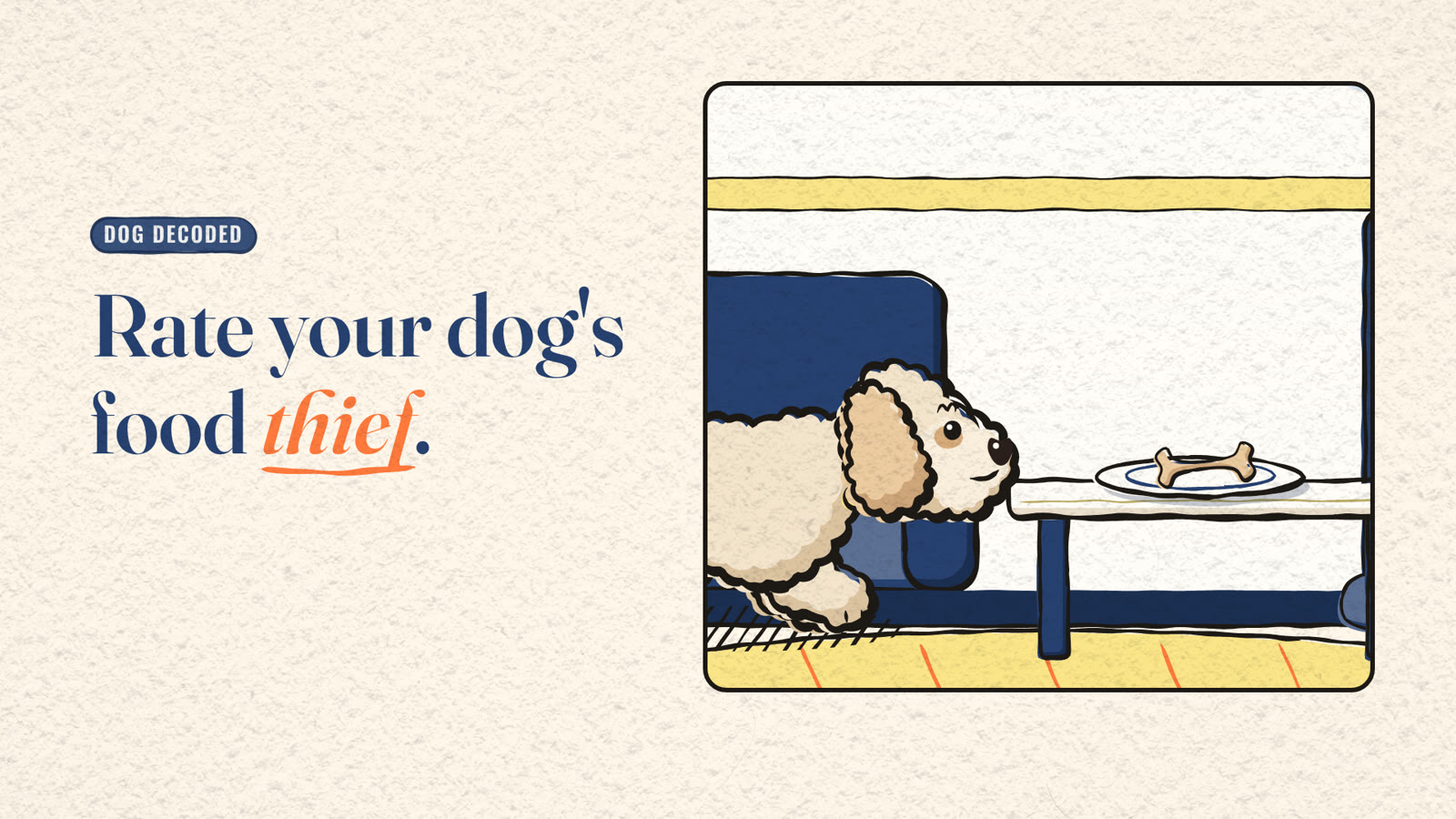
Put a biscuit on the coffee table and turn your back. Some dogs ignore it, some stare at it, and some have it gone before you turn round. Here are the five food thieves, rated for fun from saint to bin raider, why stealing sticks, how to stop it kindly, and the foods that turn a funny habit into a vet call.
Why does my dog steal food?
Because it worked. Dogs are natural scavengers, and food left within reach rewards itself: one successful grab teaches a dog that checking is worth it, whether or not anyone gave them anything.
The AKC's trainer Stephanie Gibeault puts it simply: dogs are "opportunistic scavengers by nature", and "once they discover a 'self-rewarding' act, they'll continue to do it." Even crumbs left on a counter can keep the habit going. Preventive Vet's Cathy Madson agrees: the more a behaviour is reinforced, the more a dog will choose it.
So a food thief is not a naughty dog. She is a dog who has been paid, maybe only once, for looking.
A quick word on what follows. The five levels and their ratings come from our short film and everyday behaviour lore, not from a study. The parts that matter most, the training advice and the food dangers, come from vets and trainers, linked at the end.
Want to watch the five food thieves in 85 seconds?
In our short film, Miya creeps up on a biscuit while your back is turned, and rates every level from the saint to the bin raider.
How do the five levels of food thief rate?
From least to most worrying: the saint, the stare, the floor hoover, the counter surfer and the bin raider. Levels one to four are mostly about manners. Level five matters because of what is in the bin.
| Level | What it looks like | What is usually going on | What to do |
|---|---|---|---|
| 1. The saint | Ignores your plate, may even turn away | Table food has never paid off | Keep it that way |
| 2. The stare | Sits close, does not blink | Staring worked at least once | Ignore it; reward calm on a mat |
| 3. The floor hoover | Under your chair at every meal | Crumbs fall, and crumbs count | Feed her first; a mat away from the table |
| 4. The counter surfer | Paws up on the counter when you turn | The counter is where the best smells are | Clear counters, gate the kitchen, teach leave it |
| 5. The bin raider | Lid open, wrapper on the floor | The bin is a buffet she can reach alone | A lid she cannot open, and know which foods mean a vet call |
The stare has its own post: our begging moves guide covers why it lasts and how to stop it paying off.
Does my dog really wait until I turn my back?
Quite possibly, yes. In a small 2003 study, dogs who had been told not to take food took more of it when the person turned her back, closed her eyes, got distracted or left the room.
The study, by Josep Call and colleagues in the Journal of Comparative Psychology, tested 12 dogs. When the person watched, the dogs took less of the forbidden food, approached it more indirectly and sat more often.
To be the careful version of the film:
- It was 12 dogs, tested in a lab-style setup, not a living room with a biscuit.
- It shows dogs are sensitive to whether a person is paying attention. It does not show that your dog is plotting.
So "she takes her chance when you look away" is fair. "She knows she is being sneaky" goes further than the evidence. If she looks guilty afterwards, that look is not what it seems either, as we explain in why dogs look guilty.
How do I stop my dog stealing food?
Make stealing impossible first, then teach her that leaving food pays better. Prevention does most of the work: a dog who never finds anything stops checking.
- Nothing on the edge. The AKC advises keeping food in sealed containers, cupboards or the fridge, and away from the counter edge while you cook. Preventive Vet adds: wipe up crumbs.
- A lid on the bin. A bin she can open is level five waiting to happen. Use one with a lid she cannot nose open, or keep it behind a cupboard door.
- Manage the kitchen. Preventive Vet suggests a baby gate across the kitchen doorway, or a crate or pen while you cook. In a compact flat where the kitchen is a few steps from the sofa, a gate is often the easiest fix.
- Teach leave it, with a swap. Hold a treat in a closed hand. The moment she backs off, mark it and give her a better treat from your other hand. Build up slowly to food on the floor, then on a low table. The AKC recommends strong "leave it" and "drop it" cues, and rewarding a different, good behaviour instead of scolding.
- Be consistent. The AKC warns that "any mistakes or forgotten food will set you back." One forgotten sandwich can undo a week.
What not to do: do not punish after the fact. Preventive Vet says there is no point, because a dog cannot link a telling-off to a theft that is already over. The AKC adds that punishment "can increase anxiety or lead to sneaky behavior", which is the opposite of what you want: a dog who only steals when you are out of the room.
For the swap, a tiny, strong-smelling treat works best, because it has to beat whatever is on the table.
Turkey Freeze-Dried Pet Treats (SGD $14.90): Pure turkey. Nothing else. Lean white meat that's gentle on the stomach and great for training.
Single-ingredient treats such as freeze-dried turkey break into very small pieces, so plenty of practice still counts for little in her day. Keep all treats within about 10% of her daily calories, as we explain in how many treats a dog should have. See all our freeze-dried treats.
Why is the bin raider the one vets worry about?
Because the bin and the counter are where the dangerous foods end up. Chocolate, grapes, raisins and sugar-free gum can all make a dog seriously ill, and mouldy leftovers, bones and wrappers add their own risks.
| Food | Why it is a problem | When signs can show | What to do |
|---|---|---|---|
| Chocolate | Theobromine and caffeine; darker chocolate holds far more | Usually within 6 to 12 hours | Call your vet; note the type and amount |
| Grapes, raisins, sultanas, currants | Linked to kidney failure in some dogs; no known safe amount | Vomiting in 6 to 12 hours; kidney failure in 24 to 72 hours | Call your vet now, even if she seems fine |
| Sugar-free gum and sweets (xylitol) | A fast drop in blood sugar; liver damage in larger amounts | Often within 30 to 60 minutes | Call your vet now; keep the packet |
| Mouldy leftovers | Some moulds make toxins that cause tremors and seizures | Within 1 to 2 hours or up to several hours | Call your vet |
Chocolate. The ASPCA says the darker the chocolate, the greater the risk. The Merck Veterinary Manual lists cocoa powder and baking chocolate as the richest sources and milk chocolate as much lower, and says dogs clear theobromine slowly, with a half-life of 17.5 hours. Merck also warns that "individual susceptibility to methylxanthines varies", so do not do the maths at home. The fat in chocolate "may trigger pancreatitis in susceptible animals", Merck adds.
Grapes and raisins. Merck says they have been associated with kidney failure "in some dogs". Nobody can yet predict which dogs: tartaric acid is "one proposed toxic principle", and the ASPCA calls it "speculated", so the cause is still a hypothesis. Merck includes Zante currants with grapes and raisins. With Christmas a month away, fruit cakes and mince pies are worth keeping well out of reach.
Sugar-free gum. Many sugar-free gums and sweets contain xylitol. Cornell's Riney Canine Health Center says it can cause very low blood sugar within 30 to 60 minutes, and liver damage after larger amounts. The amount varies "wildly" between products, so there is no simple safe number. It is also in some peanut butters and baked goods.
The rest of the bin. The ASPCA warns that bones can injure or block the gut, and lists onions and garlic among foods to avoid. Merck links mouldy food waste to tremorgenic mycotoxins, which can cause vomiting, tremors and seizures, and its advice for prevention is keeping dogs away from food waste.
What should I do if my dog ate chocolate, grapes or gum?
Call your vet now, before any signs appear. Tell them what she ate, how much and when, keep the wrapper, and do not try to make her sick yourself.
- Don't wait for signs. Dr Tina Wismer of the ASPCA Animal Poison Control Center, quoted by the University of Illinois College of Veterinary Medicine, says "Don't wait", and that signs can take hours or even days to show. A dog with grapes or raisins on board can look perfectly well the next morning.
- Gather the facts. Her weight, the food, roughly how much, and when. Bring the label or packaging; Cornell says it helps the vet estimate the dose.
- Never make her sick at home. Illinois says plainly: "Never try to induce vomiting in your pet at home." That is a vet's decision.
- Know your nearest 24-hour clinic. The poison hotlines on American sites are US services, so in Singapore your own vet or an emergency clinic is the first call. Look up the nearest one now, not at 2am.
For a fuller guide to festive sweets, see Halloween sweets that are dangerous for dogs.
Bottom line
Most food thieves are not naughty, they are paid. Keep food off the edge, put a lid on the bin, and teach leave it with a swap so backing off earns her something better. Rate your dog for fun, but take level five seriously: if she gets into chocolate, grapes, raisins or sugar-free gum, call your vet now and don't wait for signs.
For leave-it practice, our Turkey Freeze-Dried Pet Treats are 100% turkey and easy to break small. They ship within Singapore, within 24 hours. First order? Use code TRY25NOW for 25% off orders of $25 or more (up to $10 off).
Saint to bin raider: which number is yours?
Frequently asked questions
Why does my dog steal food when I leave the room?
Because food within reach rewards itself, and dogs notice when nobody is watching. In a 2003 study of 12 dogs, dogs took more forbidden food when the person turned her back, closed her eyes or left the room. It was a small study, but it fits what trainers see: manage the space, not just the dog.
Should I tell my dog off for stealing food?
Not after the fact. A dog cannot link a telling-off to a theft that is already over, and the AKC warns punishment can increase anxiety or lead to sneaky behaviour. Prevent access instead, interrupt calmly if you catch her mid-reach, and reward her generously for leaving food alone.
How do I teach my dog leave it?
Hold a treat in a closed hand. When she stops nudging and backs off, mark it and give her a better treat from your other hand. Practise in short sessions, then move to food on the floor and on a low table. Never let her win the food she was asked to leave.
My dog ate chocolate but seems fine. Should I wait?
No. Call your vet now. Merck says chocolate signs usually appear within 6 to 12 hours, and grape or raisin kidney damage can take 24 to 72 hours, so a dog who looks well is not in the clear. Tell your vet her weight, what she ate, how much and when.
Is one piece of sugar-free gum dangerous for a dog?
It can be. Many sugar-free gums contain xylitol, which can drop a dog's blood sugar within 30 to 60 minutes, and the amount varies widely between brands. Cornell says even a small amount can cause severe problems. Call your vet straight away and keep the packet so they can check the ingredients.
Sources
- AKC (Stephanie Gibeault, MSc, CPDT): How to get your dog to stop counter-surfing
- Preventive Vet (Cathy Madson, CPDT-KA): How to stop your dog from counter surfing
- Call, Bräuer, Kaminski and Tomasello (2003), Domestic dogs are sensitive to the attentional state of humans, Journal of Comparative Psychology 117(3):257-263
- ASPCA Animal Poison Control: People foods to avoid feeding your pets
- Merck Veterinary Manual: Chocolate toxicosis in animals
- Merck Veterinary Manual: Grape, raisin and tamarind toxicosis in dogs
- Cornell Riney Canine Health Center: Xylitol toxicities
- Pet Poison Helpline: What happens if my dog eats gum?
- Merck Veterinary Manual: Tremorgenic neuromycotoxicosis in dogs
- University of Illinois College of Veterinary Medicine: What to do when your pet gets into household toxins
This article is general information, not veterinary advice. If your pet has ongoing symptoms, see your vet.